
The research, funded by the Nuffield Foundation and supported by the NSPCC, used quantitative and qualitative methods, according to UCL and Nuffield. Its quantitative work used the Millennium Cohort Study, a nationally representative longitudinal study following about 19,000 children born in the UK between 2000 and 2002. GCSEs are England's main school-leaving examinations, usually taken at age 16.
UCL said children in England who experienced physical punishment at ages three, five and seven were 5.7 percentage points more likely not to achieve five GCSE grades A* to C, or grades nine to four, including English and maths, after other factors were taken into account. UCL reported the adjusted comparison as 48% versus 42.3%.
The same release said adolescents who had experienced any physical punishment in early childhood, from ages three to seven, were 33% more likely at age 14 to have engaged in risky behaviours toward others. UCL listed higher reported risks for having hit, pushed or shoved someone, bullying siblings, cyberbullying and other bullying.
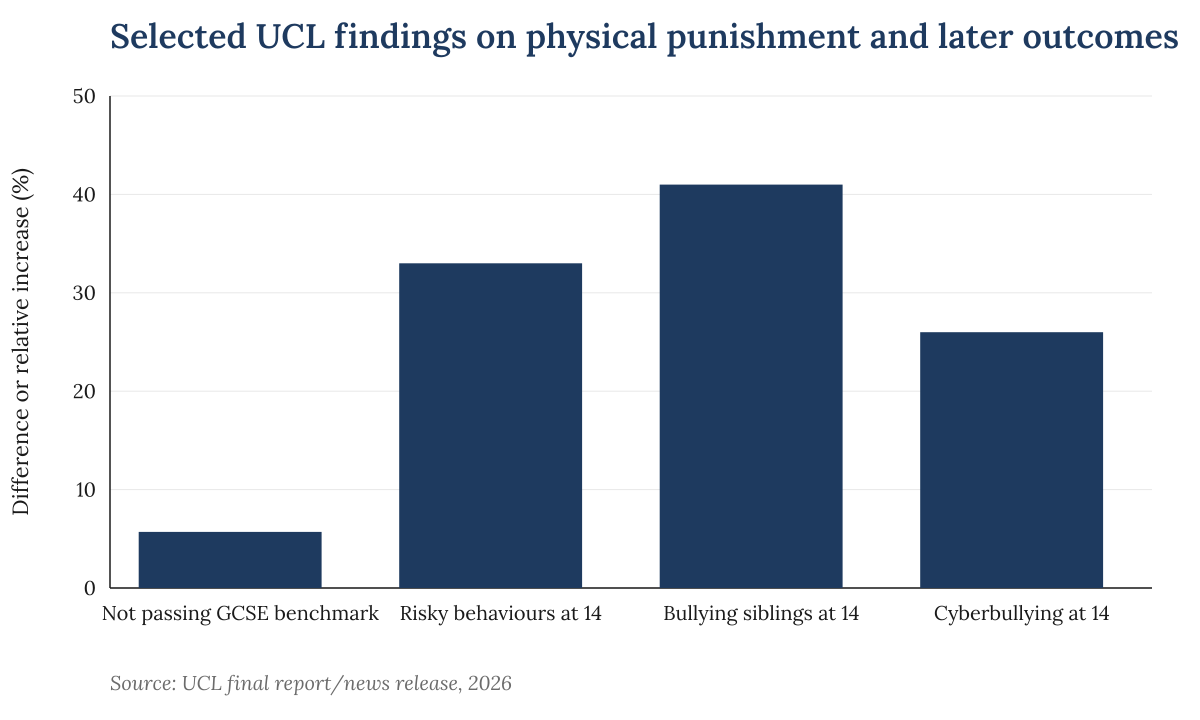 Selected UCL findings on physical punishment and later outcomes. Source: UCL final report/news release, 2026.
The study is policy-relevant because the legal position differs across the UK and Ireland. UCL said physical punishment is outlawed in Scotland, Wales and the Republic of Ireland, but parents in England and Northern Ireland can still rely on a defence of reasonable punishment. Nuffield's project page describes that defence as effectively allowing a parent to claim a lawful defence to common assault of a child in those jurisdictions.
Lead author Anja Heilmann of UCL Epidemiology and Public Health said the findings supported previous evidence that physical punishment had no benefits and was linked to detrimental outcomes for children's development and wellbeing. Co-author Becca Lacey of City St George's, University of London said the research associated physical punishment with poorer educational attainment and adolescent antisocial behaviours.