
The ONS said monthly real gross domestic product, a measure of inflation-adjusted output across the economy, fell for the first time since August 2025, when GDP declined by 0.2%. Services output fell by 0.2% in April, production showed no growth and construction rose by 0.1%, according to the same release.
The monthly fall did not erase the stronger three-month picture. ONS figures show real GDP grew by 0.7% in the three months to April compared with the three months to January, after growth of 0.6% in the three months to March and 0.5% in the three months to February. The House of Commons Library's GDP indicators briefing also records the 0.1% April fall after 0.3% growth in March.
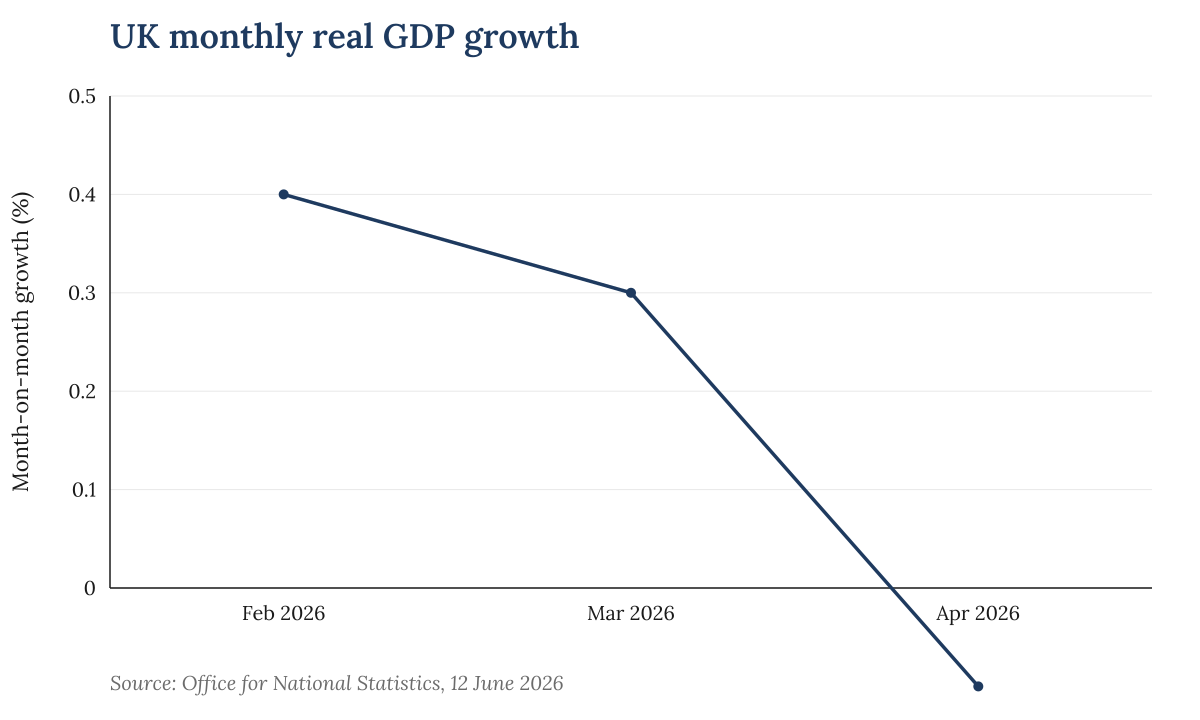 UK monthly real GDP growth. Source: Office for National Statistics, 12 June 2026.
The services decline was broad enough to matter for the headline number. The ONS said eight of 14 services subsectors fell in April. Administrative and support service activities fell by 2.2%, while arts, entertainment and recreation fell by 4.3%. Within that category, sports activities and amusement and recreation activities fell by 9.1%, making the industry the largest single negative contributor to services output and real GDP growth, according to the ONS.
The ONS attributed some of the sports and recreation fall to Middle East conflict effects, citing cancellations of multiple sporting events in the region that affected UK-based businesses. In a separate cross-industry section, the agency said businesses in manufacturing, wholesale, warehousing, accommodation and travel agencies had reported reduced turnover connected to the conflict, while many comments referred to higher energy and fuel costs. The ONS also said it was difficult to quantify the exact impact of those themes.
That distinction matters because the April GDP estimate is not a full causal decomposition of the war's effect on UK output. The Guardian reported on 12 June that the contraction followed economic disruption linked to the Iran war and higher energy prices, but the ONS release itself frames the conflict evidence as business survey commentary rather than a measured contribution to the 0.1% fall.
Construction supplied a small offset. The ONS said monthly construction output grew by 0.1% in April, driven by repair and maintenance, while new work fell by 0.3%. Over the three months to April, construction output rose by 1.6%, continuing what the agency called a partial recovery after five consecutive three-monthly falls from October 2025 to February 2026.