Carbon Brief said solar produced 1,727 terawatt-hours across its Asia dataset in the 12-month period, just ahead of gas at 1,711 TWh. It said the result made solar the continent's third-largest electricity source, behind coal and hydropower.
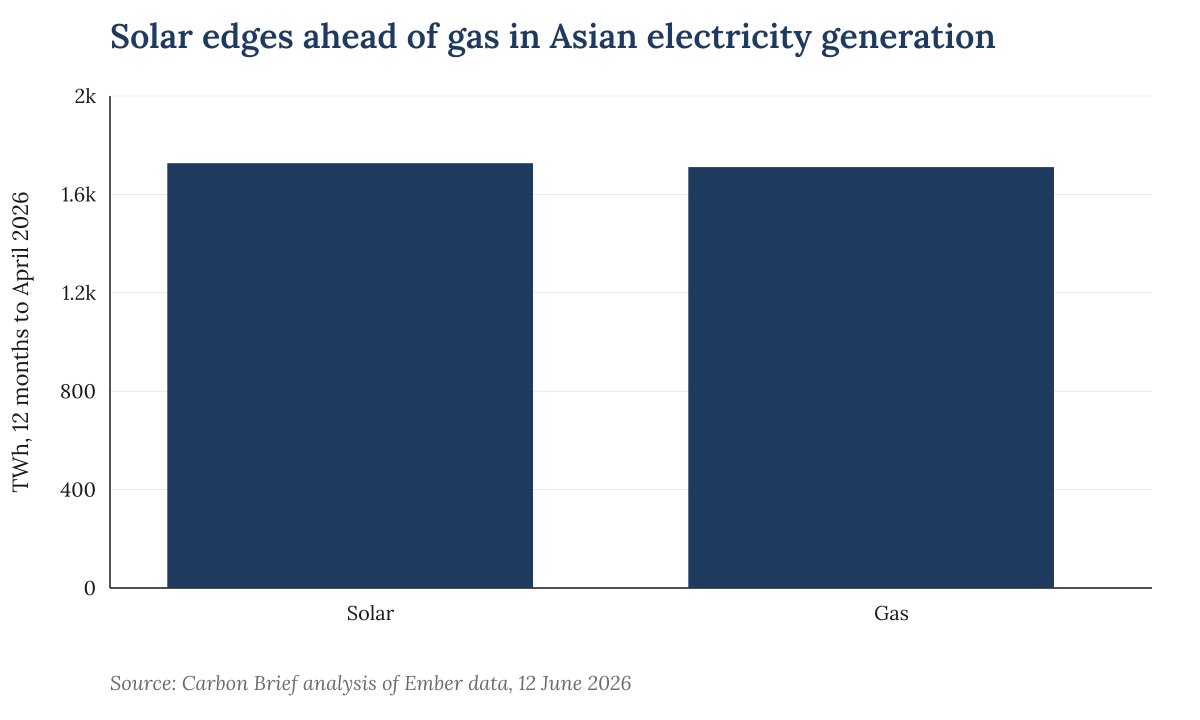 Solar edges ahead of gas in Asian electricity generation. Source: Carbon Brief analysis of Ember data, 12 June 2026.
The margin is narrow, but the direction is larger than a one-month swing. Carbon Brief said Asian solar output had increased nearly fourfold since 2020, driven by expansion in countries including China, India and Pakistan. The same analysis said Asia accounted for about 60% of global solar-power growth since 2020.
Coal still dominates the region's power mix. Carbon Brief said coal generated roughly 52% of Asia's electricity each year, while hydropower generated about 12%. The solar-gas crossover therefore marks a shift within the middle of the generation stack, not a displacement of coal as the continent's main electricity source.
Carbon Brief's methodology is also material. The analysis used Ember annual and monthly electricity data and rolling annual totals. Its definition of Asia includes China, India, Japan, South Korea, Pakistan, Bangladesh, Indonesia and many other countries, but excludes several countries that are geographically in Asia and use large amounts of gas, including Iran, Saudi Arabia, the United Arab Emirates and Russia.
The gas comparison has a second caveat: power capacity and power generation are different measures. Carbon Brief said Asian gas-power capacity increased by 22% between 2019 and 2024, while gas-fired generation rose by only 6% over the same period. It said supply disruptions, relatively high gas prices and growth in clean alternatives had limited gas generation in many markets, though trends varied by country.
Ember's Global Electricity Review 2026 gives the crossover wider context. Ember said record solar growth helped low-carbon power generation rise by 887 TWh in 2025, outpacing electricity-demand growth of 849 TWh. It also said clean generation pushed fossil-fuel power into a small decline in 2025, the first such fall since 2020 and only the fifth this century.