The paper, "Decoupled carbon assimilation and growth responses to aridity in temperate deciduous oaks," examined 137 tree-ring sites in the eastern United States and California, according to Science Advances and Columbia Climate School. The researchers combined photosynthesis-detecting satellite imagery, hourly treetop carbon dioxide measurements, trunk sensors and growth-ring records to compare carbon uptake with wood growth.
The result is a warning about a common model assumption. Columbia Climate School says much long-term forest carbon storage depends on trees turning carbon absorbed through photosynthesis into woody biomass. The study found that higher photosynthesis did not always mean more wood growth, especially under dry and hot conditions.
At eastern U.S. oak sites, Columbia Climate School and EurekAlert said roughly 36% of annual carbon assimilation through photosynthesis occurred after growth had stopped in late summer. At California oak sites, the reported post-growth share was about 26%.
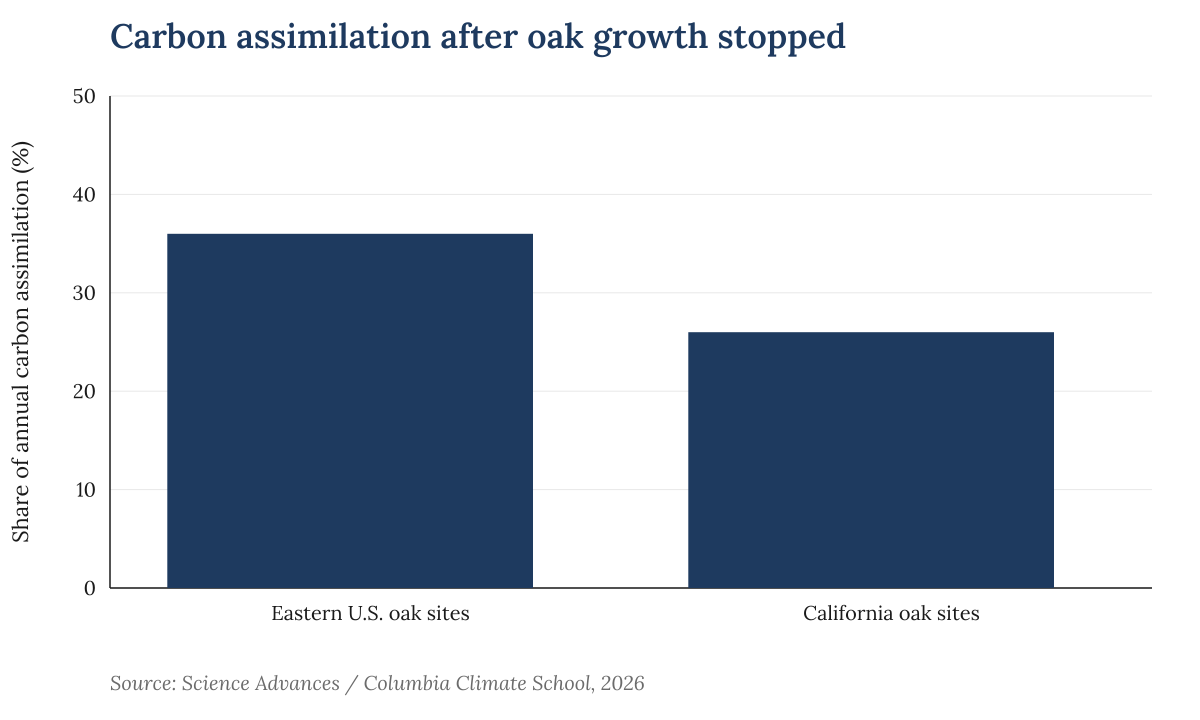 Carbon assimilation after oak growth stopped. Source: Science Advances / Columbia Climate School, 2026.
Lead author Mukund Palat Rao, an ecoclimatologist at Columbia's Lamont-Doherty Earth Observatory, told Columbia Climate School that models often assume photosynthesis and growth move together, while the study found that they can separate. The Guardian separately reported Rao's warning that more photosynthesis does not necessarily mean more future tree growth.
The mechanism is water stress. Columbia Climate School said the detailed site measurements showed wood growth was restricted to periods of lower aridity and temperature. Rao told Columbia that growth can stop quickly in dry and hot conditions while photosynthesis continues at a reduced rate.