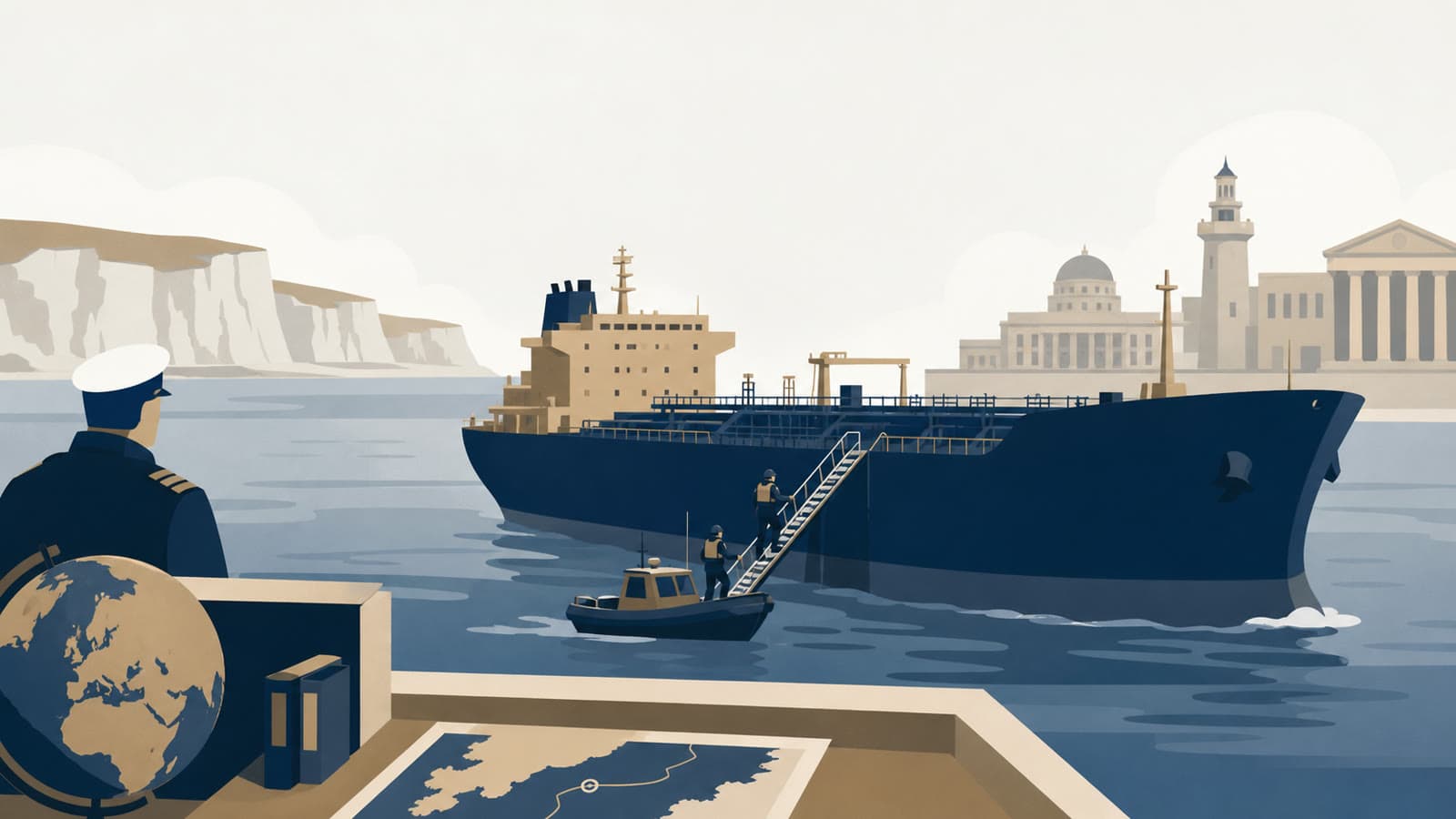
The Ministry of Defence said Royal Marine Commandos and National Crime Agency officers boarded the vessel in a six-hour operation supported by Chinook, Merlin Mk4 and Wildcat aircraft, an RAF P-8 aircraft, HMS SUTHERLAND and HMS LEDBURY. The ministry said SMYRTOS would be moved provisionally to an anchorage off England's south coast and monitored for environmental or safety concerns while investigations continue.
The legal basis is central to the story. The ministry said the enforcement action took place in international waters and was carried out in accordance with domestic and international law. It also said Prime Minister Keir Starmer had agreed in March that British armed forces and law-enforcement officers could board shadow-fleet vessels. A 25 March GOV.UK release said the UK had authorised interdiction of sanctioned vessels transiting UK waters as part of a wider sanctions-enforcement effort with Joint Expeditionary Force partners.
The March authorisation helps explain why the 14 June boarding was not an isolated patrol decision. The earlier GOV.UK statement said Britain intended to put pressure on sanctioned vessels using UK waters, including the Channel, and referred to recent operations by Finland, Sweden and Estonia against suspected illegal shadow-fleet vessels in the Baltic. The Channel operation therefore fits a broader European pattern: governments are trying to turn sanctions lists into operational constraints on ships, not only financial restrictions on paper.
The Guardian reported that the operation targeted the Smyrtos after Starmer directed the action and that the tanker was anchored off Dorset after the boarding. AP reported that the vessel had departed Ust-Luga in Russia and was heading for Port Said, Egypt, and described it as Cameroon-flagged. The UK government statement did not give a cargo volume in the release reviewed for this draft, so this article does not state one as fact.
The geopolitical purpose is sanctions enforcement. The Ministry of Defence said the shadow fleet of more than 700 vessels was responsible for carrying 75% of Russia's sanctioned oil, and said Britain had sanctioned almost 600 Russian shadow-fleet vessels to date. It said UK sanctions were intended to reduce resources sustaining Russia's war in Ukraine and that Russian oil and gas revenues fell by 24% year on year in 2025.