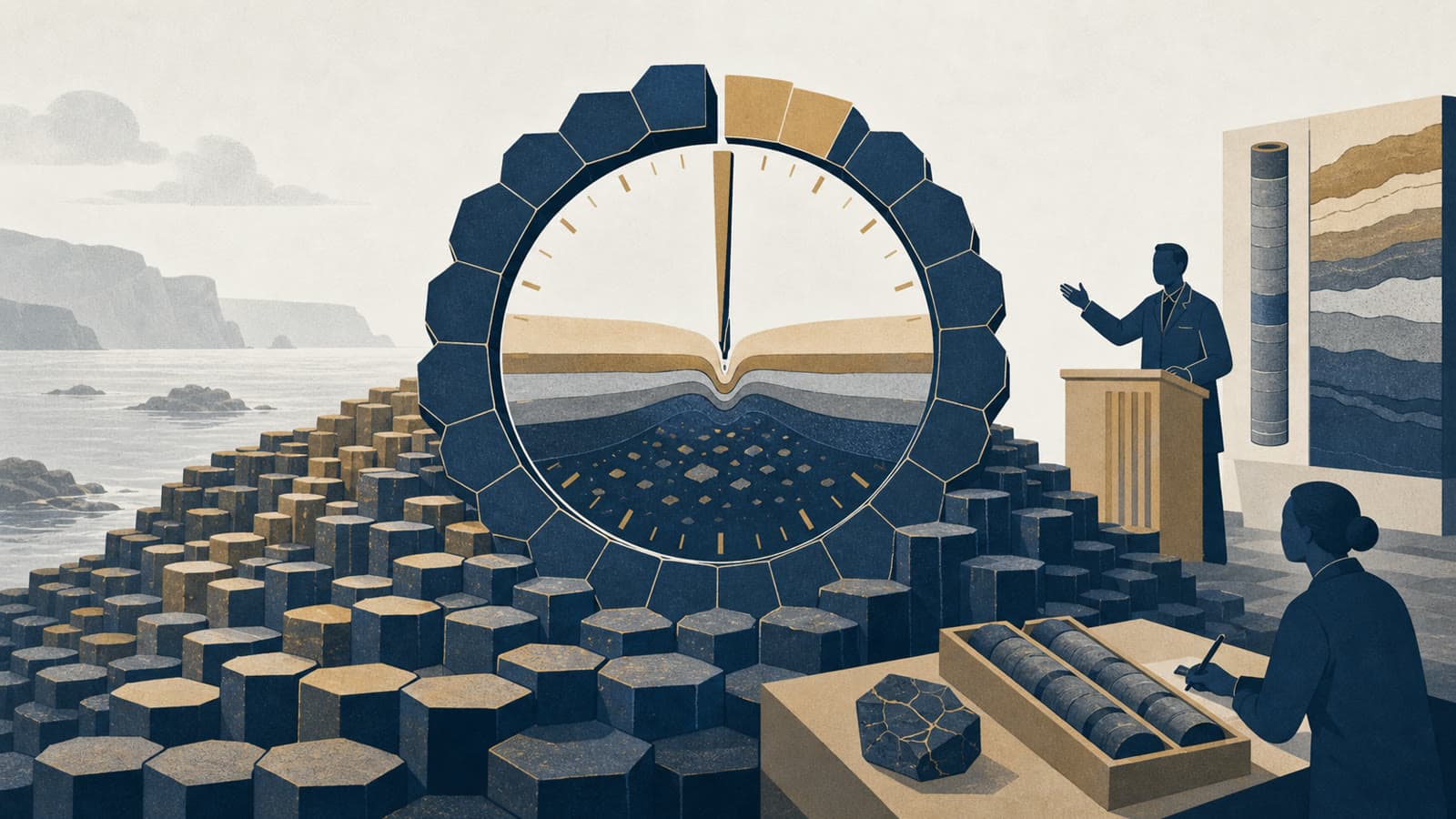
The paper, "Feeling the pulse? Paleogene chronostratigraphy of Northern Ireland and the north of Ireland temporally coupled to the North Atlantic Igneous Province", is published in Geology with DOI 10.1130/G54157.1. Its authors are Mark R. Cooper, Simon Tapster and Daniel J. Condon, according to the journal record.
Geochronology means dating rocks and geological events. The Guardian reported that the researchers used high-resolution dating to reassess volcanic rocks across Northern Ireland and the north of Ireland, tying the first lava flows on the Northern Irish plateau more closely to the North Atlantic Igneous Province, the large volcanic province associated with the opening of the North Atlantic.
The revision is about timing, not the basic physical process that formed the columns. The British Geological Survey describes the Giant's Causeway as more than 40,000 basalt columns and says the site, with the wider Causeway Coast, records events at the start of the Paleogene period about 60mn years ago. UNESCO describes the site as an area of global geological importance with polygonal basalt columns formed around 60mn years ago.
The new work refines where the Northern Irish rocks sit in that wider volcanic history. The Guardian reported that the study links the first lava flows on the Northern Irish plateau to volcanic activity also associated with Fingal's Cave on Staffa, the Mourne Mountains, Rum, Skye and Greenland. Simon Tapster, a British Geological Survey geochronologist and one of the authors, told the Guardian that the team had reassessed the timescales of a major North Atlantic volcanic event and found that it occurred over a shorter duration than previously thought.
The scientific counterpoint is that a tighter chronology does not by itself settle every model for why the North Atlantic Igneous Province formed. The Geology abstract says the roles of plume and rift dynamics as drivers of the province remain contested. In plain terms, the dating can better align rock units across regions, but the deeper cause of the volcanic province still depends on how researchers weigh mantle-plume, rifting and regional geological evidence.