AP reported on 15 June that energy experts expected a slow recovery even after the agreement to end the Iran war and open the strait. Daniel Evans, global head of fuels and refining research at S&P Global Energy, told AP that companies would need confidence in safety and insurance before restarting assets and moving vessels through the waterway:
The market reaction was immediate but incomplete. AP reported that Brent crude was down USD 3.45 at USD 83.89 a barrel early Monday, while US benchmark crude was down USD 4.03 at USD 80.85. Trading Economics, which tracks Brent contracts for difference, showed Brent at USD 83.24 a barrel on 15 June, down 4.68% on the day and still 13.67% higher than a year earlier:
The price move reflects expectations of reopening, not proof that full transit has resumed. The US Energy Information Administration says the Strait of Hormuz is one of the world's most important oil transit chokepoints. Oil flow through the strait averaged 20 million barrels per day in 2024, equivalent to about 20% of global petroleum liquids consumption, and the strait also carried about one-fifth of global liquefied natural gas trade, mainly from Qatar:
The alternative routes are much smaller than the normal flow. The EIA estimates that Saudi Arabia and the United Arab Emirates have about 2.6 million barrels per day of available pipeline capacity that could bypass the strait during a disruption. It cites Saudi Aramco's East-West pipeline to Yanbu on the Red Sea and the UAE pipeline to Fujairah on the Gulf of Oman as the main alternatives:
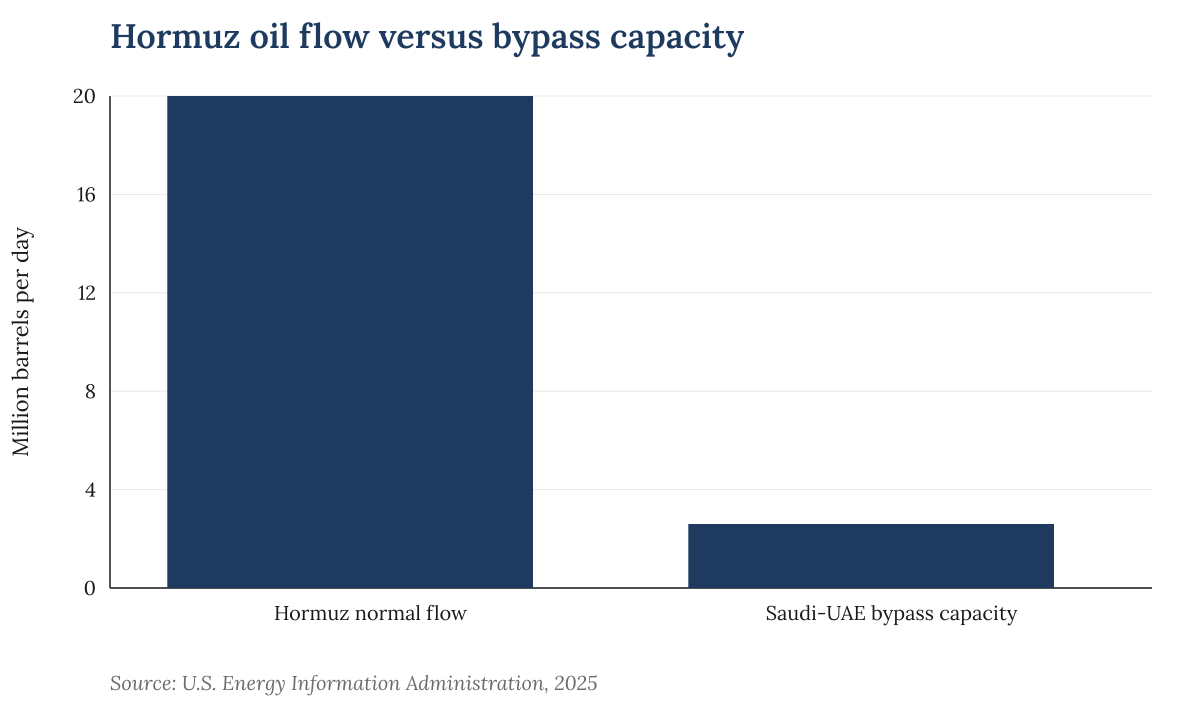 Normal Strait of Hormuz oil flow and estimated Saudi-UAE bypass capacity. Source: U.S. Energy Information Administration, 2025.
That gap is why the operational restart matters. The EIA says most volumes that normally transit the strait have no alternative means of leaving the region. It also says 84% of crude oil and condensate and 83% of liquefied natural gas moving through Hormuz went to Asian markets in 2024, with China, India, Japan and South Korea accounting for 69% of Hormuz crude and condensate flows: