
The study by Kathryn M. Berg and Dervil M. Dockrell was published online on April 3 in Disability and Rehabilitation. The university record describes it as a cross-sectional, mixed-methods online survey co-developed with patients and clinicians and disseminated through Ehlers-Danlos Support UK social media between September 2023 and January 2024.
The Guardian reported nation-level averages from the survey: 21.7 years in Wales, 21.1 years in Northern Ireland, 19.5 years in Scotland and 19.0 years in England. The same article said the survey included more than 2,000 people and described the delays as evidence of uneven access to diagnosis and care for hypermobility conditions.
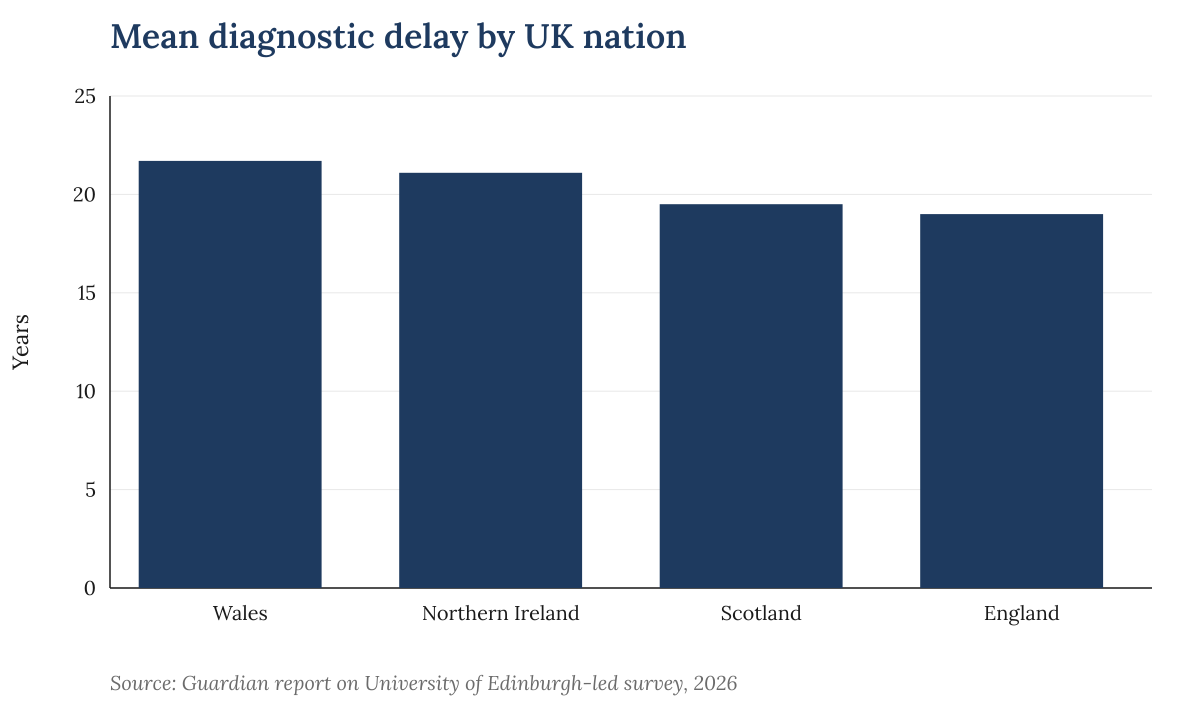 Mean reported diagnostic delay by UK nation. Source: Guardian report on University of Edinburgh-led survey, 2026.
The university record reports that respondents were predominantly female, at 90.9%, and that the study received 2,002 valid responses. It reports common symptoms including chronic pain at 83.9%, joint subluxations at 73.8% and gastrointestinal manifestations at 66.3%. It also reports unemployment at 45.6%, disrupted education at 55.9% and benefit dependence at 47.9% among respondents.
The clinical context is that hypermobile Ehlers-Danlos syndrome, or hEDS, is diagnosed clinically rather than by a single genetic test. GeneReviews, an NIH-hosted clinical reference, says hEDS diagnosis in adults is based on the 2017 international clinical diagnostic criteria and that no underlying genetic, epigenetic or metabolomic cause has been identified for hEDS.
That makes diagnosis different from many single-gene disorders. GeneReviews describes hEDS as involving generalized joint hypermobility, joint instability, pain and other manifestations, and says subluxations and dislocations may occur spontaneously or with minimal trauma. The survey findings should therefore be read as evidence about patient-reported diagnostic journeys and service access, not as a prevalence estimate for the UK population.