
The Lancet record describes SUCCESSOR-2 as a phase 3, open-label, randomised controlled trial at 160 hospital-based sites in 26 countries. The ASCO abstract identifies the study as NCT05552976 and says it evaluated mezigdomide, carfilzomib and dexamethasone against carfilzomib and dexamethasone in relapsed or refractory multiple myeloma.
Dana-Farber said Paul G. Richardson and colleagues randomly assigned 479 adults: 288 to the mezigdomide combination and 191 to carfilzomib and dexamethasone alone. The institute said patients had received at least one and up to eight prior lines of treatment, and that their disease had returned or stopped responding to therapy.
Bristol Myers Squibb, the sponsor, said the median age was 68, that 25.1% of patients were at least 75, and that the median number of prior therapies was two. The company said 92.1% of patients were triple-class exposed, 85.8% were refractory to an anti-CD38 monoclonal antibody, 75.8% were refractory to lenalidomide and 7.3% had been exposed to anti-BCMA treatment.
After a median follow-up of 10.6 months, Dana-Farber said patients receiving the mezigdomide triplet had median progression-free survival of 18 months, compared with 8.3 months in the control group. Bristol Myers Squibb reported a hazard ratio of 0.48 with a p value below 0.0001, which it described as a 52% reduction in the risk of disease progression or death.
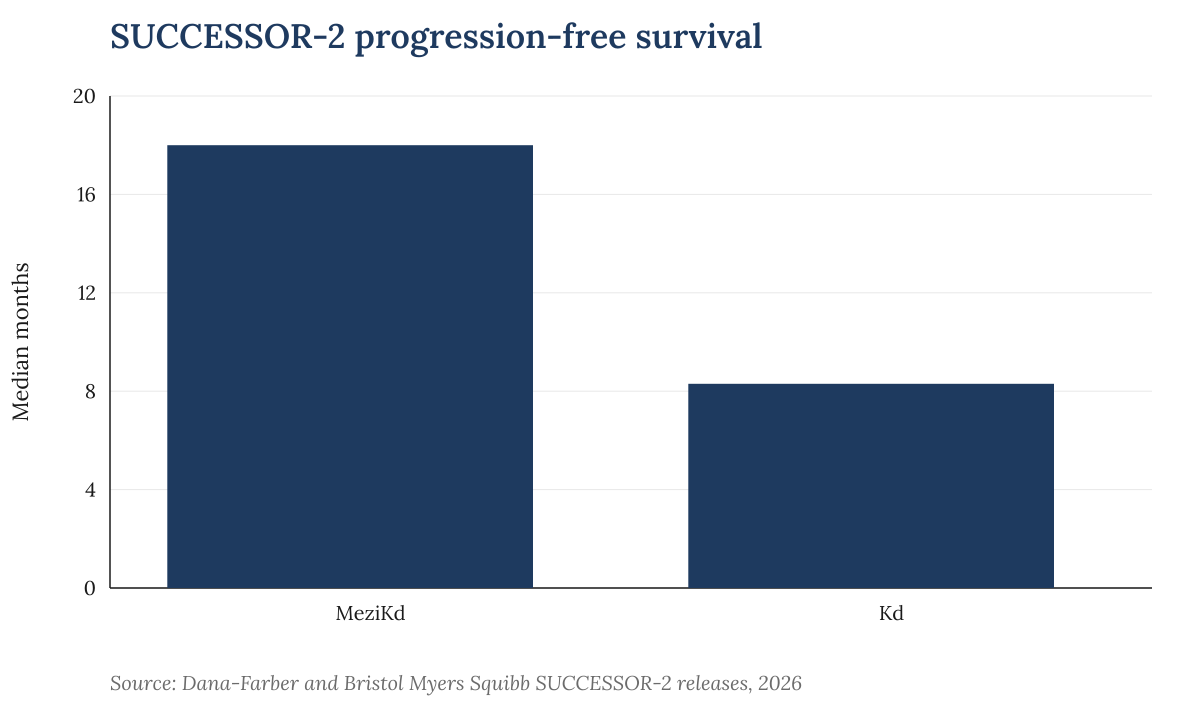 SUCCESSOR-2 progression-free survival. Source: Dana-Farber and Bristol Myers Squibb SUCCESSOR-2 releases, 2026.
Response measures also favoured the triplet in the released data. Dana-Farber and Bristol Myers Squibb both reported an overall response rate of 80.2% with mezigdomide, carfilzomib and dexamethasone, compared with 53.4% in the control group. They reported complete response or better in 26.7% of patients on the triplet and 8.9% on carfilzomib and dexamethasone alone.
The safety signal was material. Bristol Myers Squibb said grade 3 or 4 treatment-emergent adverse events occurred in 83.7% of patients receiving the mezigdomide triplet and 56.5% of patients in the control group. The company reported neutropenia, meaning low neutrophil white blood-cell counts, in 61.1% versus 9.1%, and infections in 34.0% versus 15.6%.