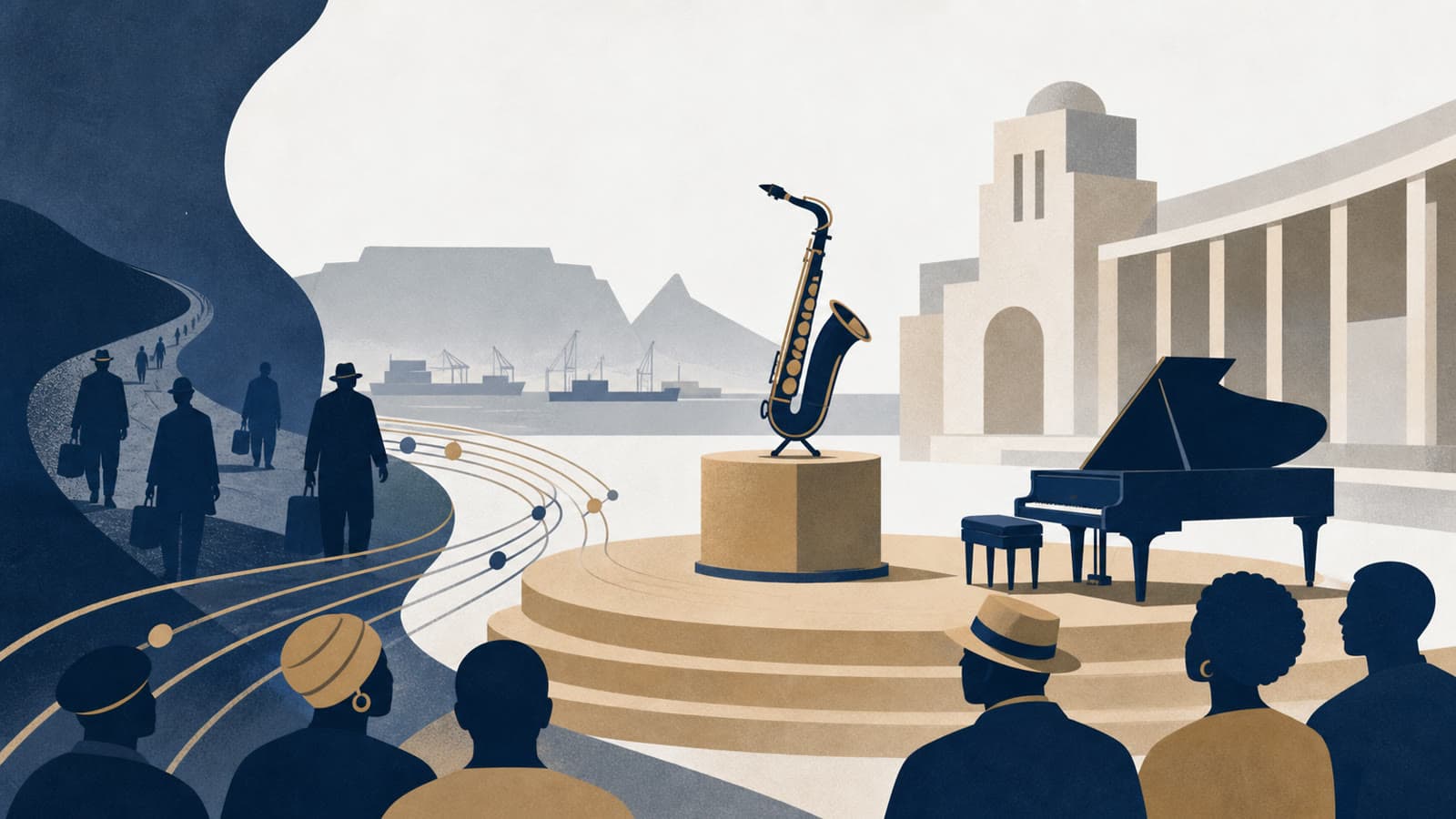
The musician born Adolph Johannes Brand, and known early in his career as Dollar Brand, was not merely a South African artist who found an international audience. He helped carry Cape jazz abroad during apartheid and returned as a figure whose work had become part of the country's political and cultural archive.
The Guardian reported that Ibrahim was born in Cape Town and began composing as a child before making his professional debut at 15. In 1960 he recorded with the Jazz Epistles, whose Jazz Epistle Verse One is widely treated as the first full-length jazz LP by Black South African musicians. That chronology matters because it places Ibrahim in a generation for whom artistic modernism and political pressure arrived together.
The AP, citing his family, said Ibrahim's career spanned more than seven decades and blended jazz with South African musical traditions. That description is broad, but it captures the institutional reason his death is more than a music-page notice. Ibrahim's career made a local form legible far beyond its original scene without detaching it from Cape Town, Islam, exile or the anti-apartheid struggle.
In the 1960s, Ibrahim moved to Europe, where he met Duke Ellington. The Guardian reported that he later recorded with Ellington before relocating to New York in 1965. He converted to Islam in 1968 and took the name Abdullah Ibrahim. The sequence is familiar in jazz biography: a local player leaves home, finds wider networks, changes the scale of his audience. In Ibrahim's case, departure also carried the weight of a state that targeted Black cultural life.
The work most closely tied to that history is "Mannenberg", recorded in 1974. The Guardian described it as a major anti-apartheid anthem, and South African coverage of Ibrahim's death has treated it as a marker of cultural resistance rather than simply a composition in his catalogue. The song's significance did not depend on sloganeering. Its public afterlife came from the way listeners attached political meaning to a piece rooted in place, rhythm and memory.