
GCPEA said the total was more than 40 percent higher than in 2022-23. Human Rights Watch, summarising the report on Monday, said the attacks harmed more than 10,600 students, teachers and education personnel across 83 countries. The report's title, Education under Attack 2026, is blunt, but the more important point is methodological: these are reported attacks and cases of military use, gathered across uneven conflict environments, not a complete global census.
That limitation does not make the numbers small. It makes the direction harder to dismiss. GCPEA said attacks on schools were the most common form, with more than 3,000 incidents, accounting for more than a third of all reported attacks on education and military use during the two-year period. The coalition also identified reports from 55 countries that were not in active armed conflict, a reminder that education can be targeted or disrupted outside the places usually treated as war zones.
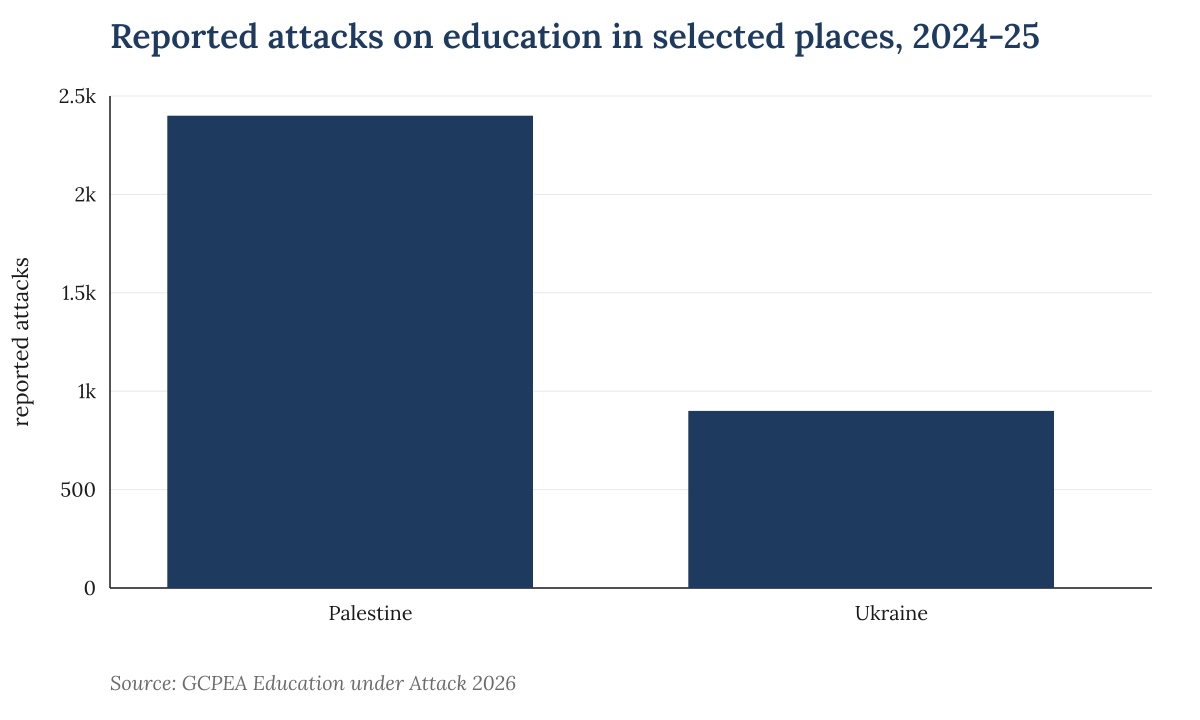 Reported attacks on education in selected places, 2024-25. Source: GCPEA Education under Attack 2026.
The concentration is stark. GCPEA recorded at least 2,400 attacks on school students, teachers and personnel in Palestine and around 900 attacks on schools in Ukraine. It also listed Colombia, Democratic Republic of the Congo, Ethiopia and Haiti among the countries with the highest incidence of attacks on education in the 2024-25 period. Those examples should not be read as a league table of suffering. They show how different conflicts produce the same institutional damage: classrooms become unsafe, teachers become targets and students lose the routine that makes education possible.