That distinction is the core of the story. A ban can remain on paper while the annual sales trajectory is softened enough to change investment decisions. The ZEV mandate is the rule that tells manufacturers how quickly their UK sales mix must shift toward zero-emission vehicles. EVA England says the mandate came into law on 3 January 2024 and is intended to rise toward 100 percent of new car and van sales by 2035.
The government's earlier consultation response described the mandate as a way to provide certainty to manufacturers, chargepoint operators and the wider market. The present backlash is therefore not only about emissions arithmetic. It is about whether companies that have invested on the basis of the existing trajectory can trust the state to hold the line when incumbent pressure rises.
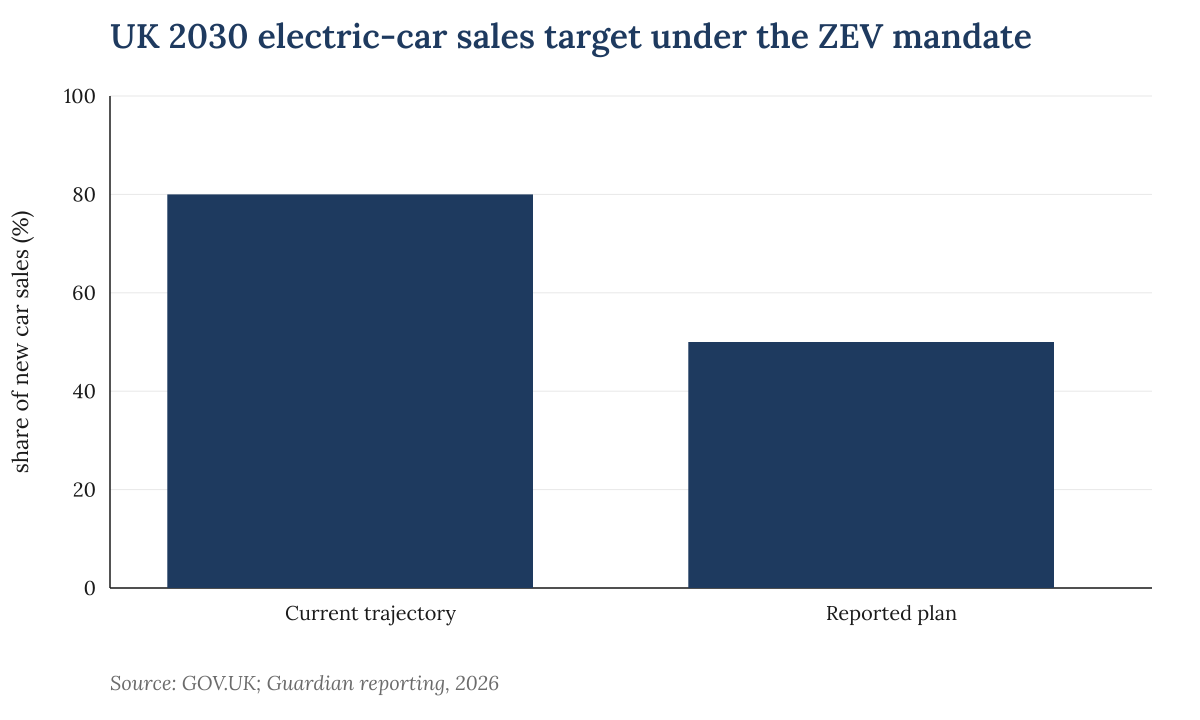 UK 2030 electric-car sales target under the ZEV mandate. Source: GOV.UK; Guardian reporting, 2026.
The Guardian reported on Sunday that the government was poised to cut the 2030 all-electric sales requirement to 50 percent. Autocar, citing the current mandate trajectory, reported that one-third of each carmaker's UK sales must be electric in 2026, rising to 80 percent in 2030. The numerical gap is large enough to change the market signal. It would give manufacturers more room to sell hybrids and combustion-engine vehicles for longer, while reducing expected demand for public charging.
Charging companies and electric-vehicle manufacturers reacted sharply. The Guardian reported that Octopus Energy chief executive Greg Jackson accused the government of choosing short-term incumbent lobbying over the long-term future of industry. It also reported that Polestar UK managing director Matt Galvin said weakening the targets would let carmakers slow EV development when they should be accelerating investment and product offerings.