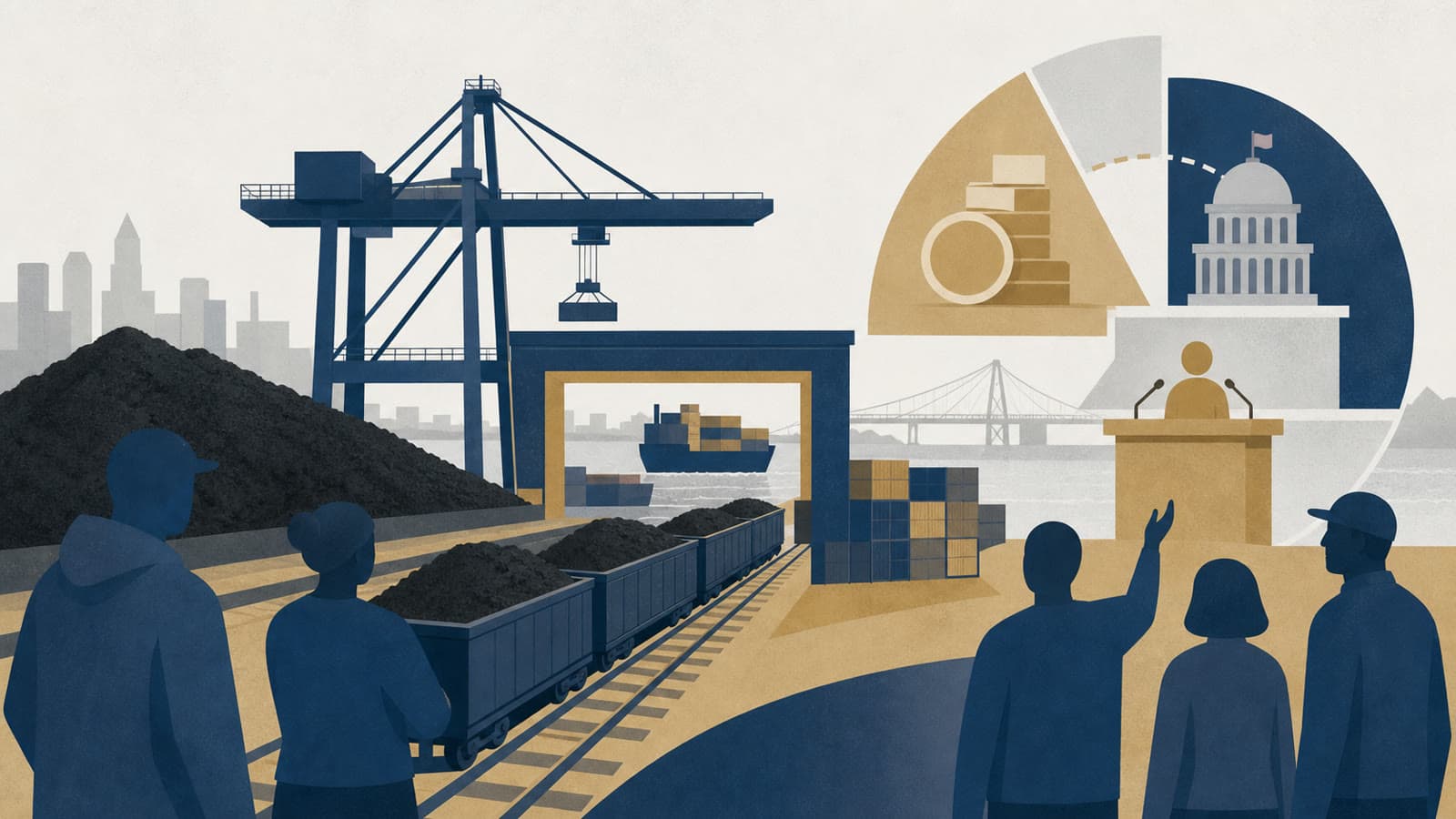
The US Department of Energy said in June that it would use Defense Production Act funding to support coal capacity projects, including up to $75mn for the West Gateway Terminal Project in Oakland, California. The department described the project as a rail-served marine export terminal that would expand West Coast export capacity and support exports to countries including Japan, South Korea, Taiwan, Vietnam and Malaysia.
For West Oakland, the announcement is not an abstract energy-policy shift. The proposed terminal sits on the former Oakland Army Base, near a neighbourhood already defined in local politics by port traffic, diesel pollution and environmental-justice organising. The Guardian reported that the Trump administration's funding revived a decade-old fight over coal dust, port land and public health.
Table: West Oakland coal terminal timeline
| Date | Event | Why it matters |
|---|---|---|
| 2016 | Oakland adopted restrictions on coal handling and storage | The city tried to block coal activity on health and safety grounds |
| 2018 | Federal litigation produced a ruling against applying the ban to the terminal | The legal path for the developer widened |
| 2025 | California appellate litigation continued over the development agreement | The dispute remained tied to contracts and city authority |
| June 2026 | DOE selected West Gateway for up to $75mn in DPA funding | Federal money revived construction and permitting questions |
Source: Department of Energy, California Court of Appeal, Guardian and Local News Matters.
The project details are now more concrete. A DOE project-selection page said the West Gateway portion of the former Army base has a 50-foot-deep harbour channel capable of handling Panamax-class bulk carrier vessels. It said Oakland Bulk and Oversized Terminal LLC aims for an initial throughput capacity of 9mn to 10mn tons, with direct rail access through Oakland Global Rail Enterprise.
Supporters frame the terminal as export infrastructure. The Energy Department said the funding would expand US coal export capacity and support energy exports to allied nations. That is the administration's strongest argument: the project is not only about Oakland, but about national industrial policy, coal supply chains and Pacific export routes.