
That is not a rooftop panel. It is still a laboratory module, roughly the area of a postcard. But it is larger than the tiny record cells that often dominate perovskite headlines, and the paper's real claim is engineering rather than spectacle: the authors say a redesigned interconnection layer helped the tandem device keep performance while moving to a larger area.
All-perovskite tandem cells stack two perovskite absorbers tuned to different parts of the solar spectrum. The promise is higher efficiency without relying on silicon as the bottom cell; the difficulty is that the layers must move charge between themselves cleanly, remain stable and be made uniformly over useful areas. In a tandem device, the tunnel recombination junction is the layer where charge carriers from adjacent subcells recombine so current can pass through the stack. If that layer absorbs too much light or degrades, the whole device loses power.
Nature's abstract said conventional gold-based tunnel recombination junctions hinder commercialisation because they cause near-infrared parasitic absorption and interfacial instability. The team replaced that approach with a solution-processed interconnecting layer based on surface-engineered indium oxide nanocrystals, then added a phosphonic acid compound to the lead-tin perovskite precursor. The paper says the combination improved carrier recombination at the interconnection layer, hole extraction and large-area film uniformity.
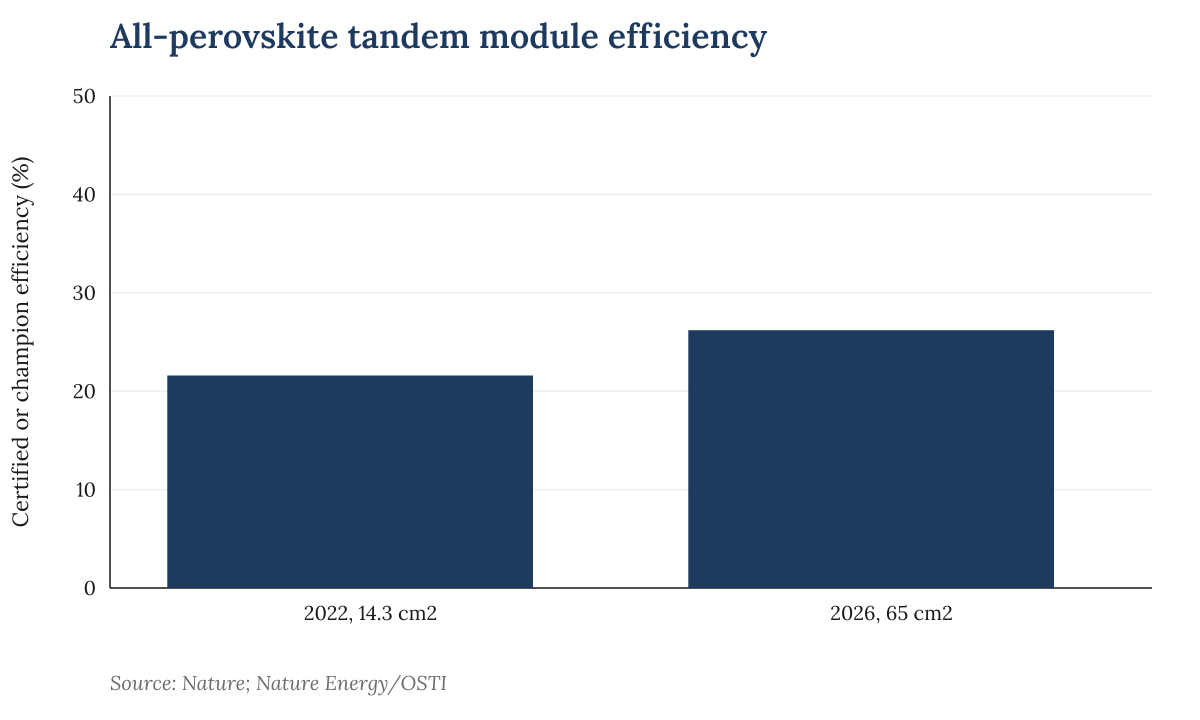 All-perovskite tandem module efficiency. Source: Nature; Nature Energy/OSTI.
The scale comparison is useful because perovskites have repeatedly looked better on small devices than on modules. A 2022 Nature Energy paper by Xuezeng Dai and colleagues, archived by the US Department of Energy's Office of Scientific and Technical Information, reported a 21.6% champion efficiency for a monolithic all-perovskite tandem module with a 14.3cm2 aperture area. The new Nature result reports 26.2% on 65cm2, a larger module and a higher certified figure.