Eurostat's May trade note put the EU's goods deficit with China at EUR98bn in the first quarter of 2026, the widest quarterly gap since the EUR107bn recorded in the third quarter of 2022. The Guardian reported on Monday that the imbalance reached EUR31.9bn in April alone, roughly EUR1bn a day, according to the latest Eurostat import and export data.
The direction is doing as much political work as the size. Eurostat said EU imports from China rose from EUR121bn in the first quarter of 2024 to EUR145bn in the first quarter of 2026, while exports slipped over the same period and the deficit widened from EUR65bn to EUR98bn. Its underlying COMEXT chart data put the quarterly deficit at EUR64.5bn in Q1 2024, EUR73.1bn in Q2, EUR85.8bn in Q3 and EUR88.0bn in Q4; through 2025 it ran at EUR90.1bn, EUR91.1bn, EUR90.2bn and EUR90.5bn before reaching EUR97.7bn in Q1 2026.
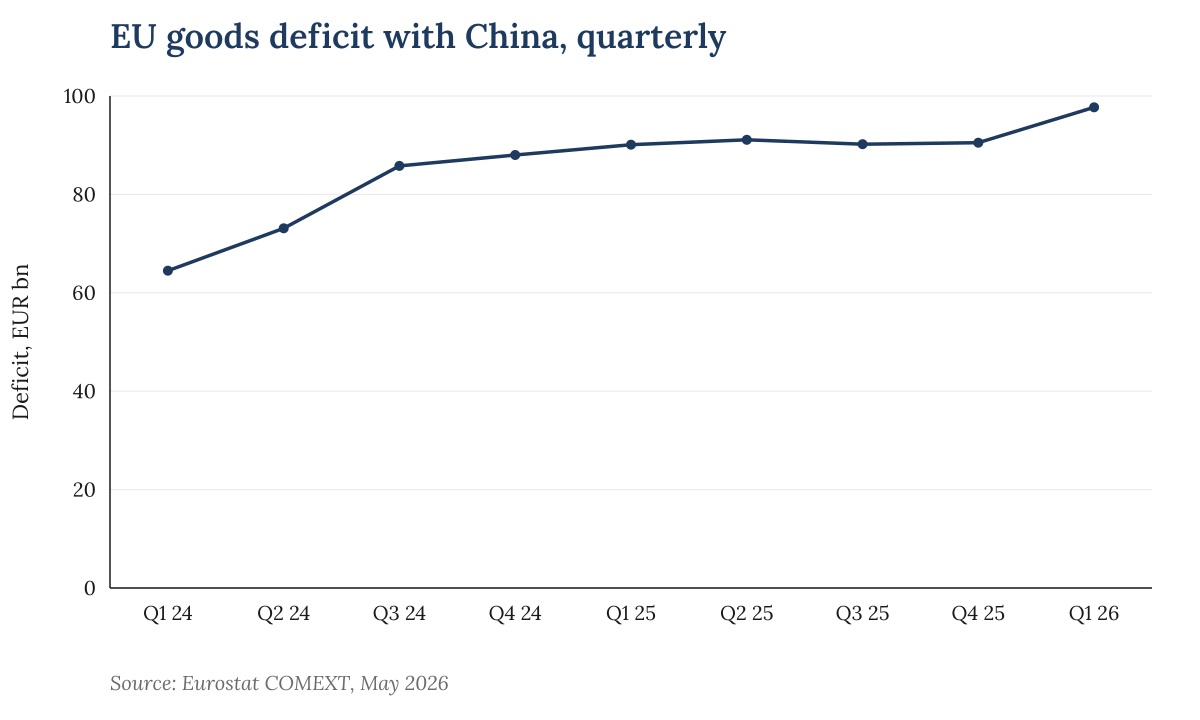 EU goods deficit with China, quarterly. Source: Eurostat COMEXT, May 2026.
That pattern matters because the deficit is concentrated in the places where Europe talks most about strategic autonomy. Eurostat said the large deficits in machinery and vehicles and in other manufactured goods have been a continuous feature of EU-China trade; chemicals and related products also sat on the deficit side in the first quarter of 2026. In 2025, the two largest product groups in EU-China goods trade were electrical equipment and machines and mechanical parts.
The immediate policy question is whether the EU treats the April figure as a macroeconomic signal, an industrial warning, or both. A bilateral goods deficit is not proof of wrongdoing. It can reflect consumer demand, corporate supply chains, exchange rates, commodity prices and the location of final assembly. But a persistent deficit in machinery, vehicles, chemicals and manufactured inputs carries a sharper political meaning than a broad current-account line: it tells ministers which capabilities are being imported, and which domestic producers are losing price-setting power.
European officials have been moving toward that interpretation. Anadolu Agency reported that after a May 29 College of Commissioners discussion, the European Commission described the current state of EU-China trade and investment relations as "not sustainable" and said its approach remained de-risking rather than decoupling. The Guardian reported that European leaders were preparing to discuss measures this week, including the presence of Chinese electric cars and the imported components used by factories across the bloc.