That makes the decision less a relief rally than a waiting period. The RBA's own statement said headline and underlying inflation were still too high, while consumer spending, housing and the labour market were all showing signs that higher borrowing costs were beginning to bite. The policy problem is the gap between those two readings: inflation has not returned to comfort, but growth is no longer brushing off the pressure.
The RBA's cash-rate table shows the sequence. The target rose to 3.85 per cent on 4 February, 4.10 per cent on 18 March and 4.35 per cent on 6 May. The 16 June decision, effective on 17 June, left the rate at 4.35 per cent.
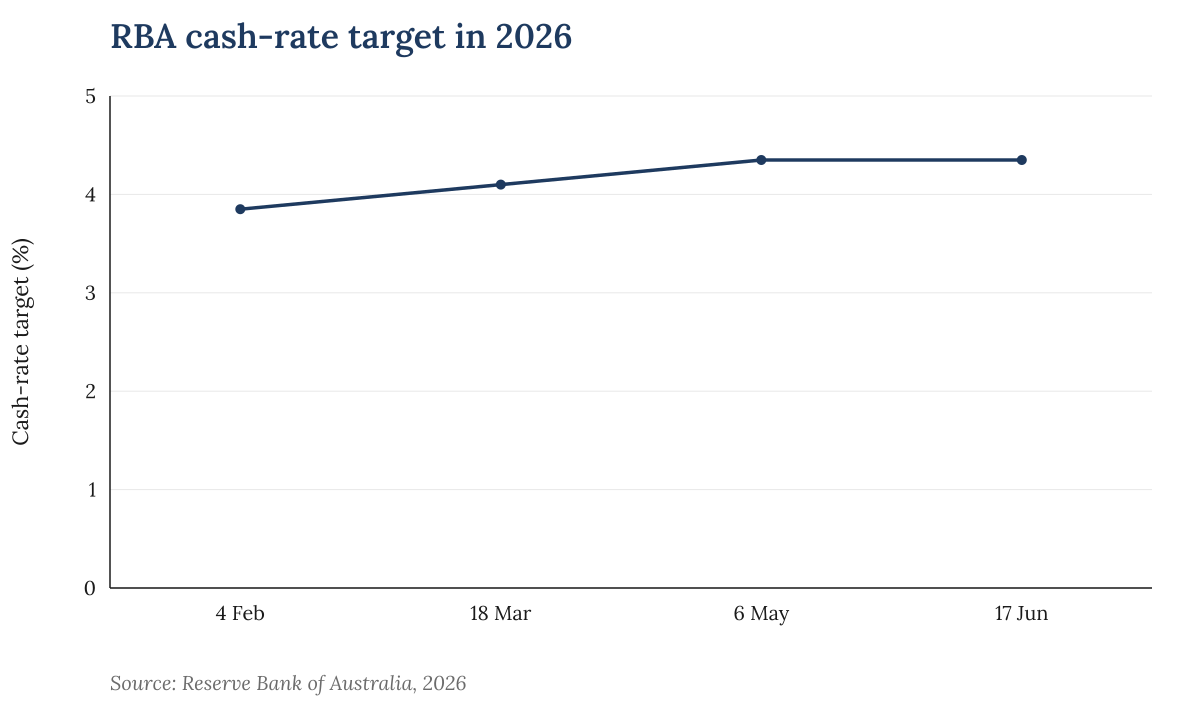 RBA cash-rate target in 2026. Source: Reserve Bank of Australia, 2026.
The hold is therefore not a pivot. It is a pause to measure the force of policy already delivered. The RBA said financial conditions had tightened this year as money-market rates and government bond yields rose and the exchange rate appreciated. It also said consumer spending growth was slowing, housing prices had fallen in some capital cities and April unemployment was higher than expected.
The inflation data explain why the board did not soften its message. The Australian Bureau of Statistics said the consumer price index rose 4.2 per cent in the 12 months to April, down from 4.6 per cent in March, but still above the RBA's 2-3 per cent target band. The ABS also said trimmed-mean inflation, a measure that strips out some large price moves, rose to 3.4 per cent in April from 3.3 per cent in March. That matters because central banks watch underlying inflation for signs that price pressure is broad rather than confined to volatile items such as fuel.
The labour-market evidence pulls the other way. ABS labour-force data showed seasonally adjusted employment fell by 18,600 in April, while the unemployment rate rose by 0.2 percentage points to 4.5 per cent. In trend terms, which smooths monthly volatility, unemployment stayed at 4.3 per cent and employment rose by 22,100. The split gives the RBA room to say conditions are cooling without treating one weak month as proof that the labour market has cracked.
Governor Michele Bullock kept that balance in the foreground. The Guardian reported that she said the board was prepared to raise rates again if needed, while also saying the RBA did not want to push the economy into recession. She described the jobs market as still "a bit tight", even after the April unemployment rise, and said the board did not consider another increase at Tuesday's meeting. The decision to hold, the Guardian reported, was unanimous.