
That figure is a goods number, not a full measure of the EU-China economic relationship. It excludes services, where the European Commission says the EU still runs a surplus with China, and it says nothing by itself about consumer gains from cheaper imports. But the direction is hard to dismiss. Eurostat's latest China trade explainer says the EU goods deficit with China widened from EUR65bn in Q1 2024 to EUR98bn in Q1 2026, as imports rose to EUR145bn and exports fell to about EUR47bn.
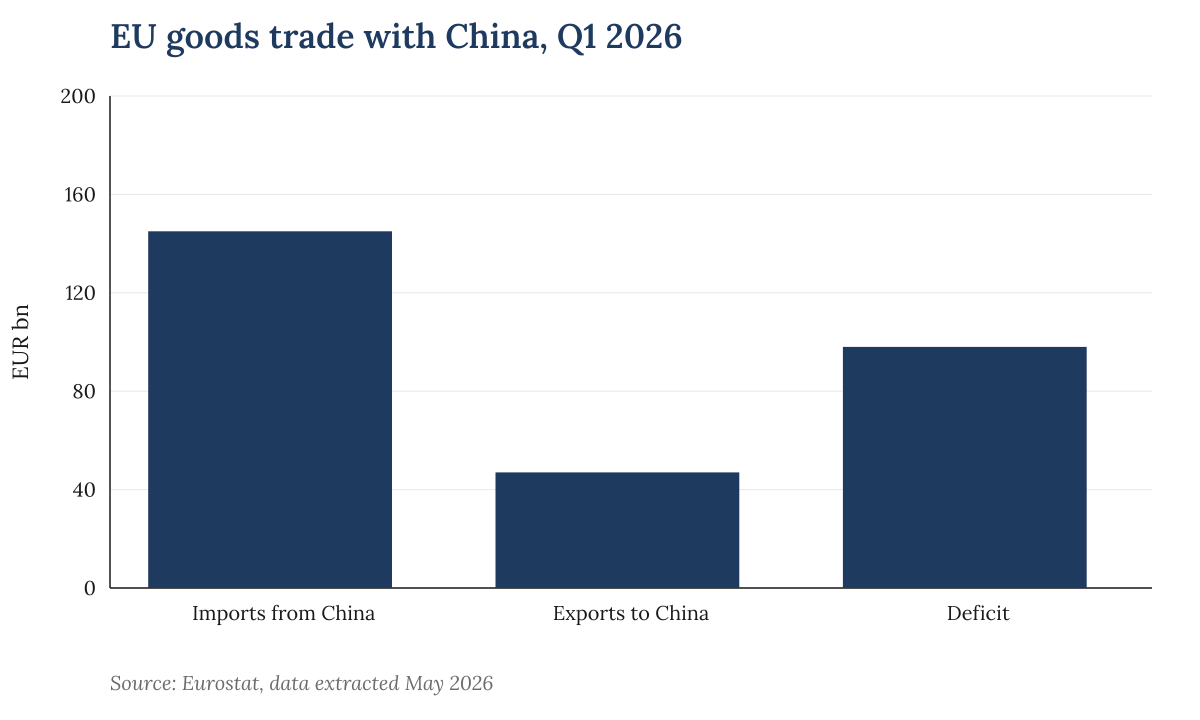 EU goods trade with China, Q1 2026. Source: Eurostat, data extracted May 2026.
The composition matters more than the headline. Eurostat says the largest persistent deficits are in machinery and vehicles and in other manufactured goods. The Commission's China trade page puts the same point in industrial terms: in 2025, manufactured goods made up 97.3% of EU imports from China, with machinery and vehicles accounting for 54.4% and other manufactured goods for 33%. EU exports to China were also mostly manufactured goods, but the scale was smaller: EUR199.5bn of exports against EUR559.5bn of imports in 2025.
This is why the trade deficit has become a policy problem rather than a statistical curiosity. The Commission says the EU is committed to "de-risking, not decoupling", meaning it wants to reduce critical supply-chain dependencies without cutting China out of European commerce. It also says China remains the EU's biggest source of goods imports and that Brussels is concerned about industrial policies, overcapacity, export controls and market-access barriers.
The risk for Europe is not that every bilateral deficit is evidence of damage. A 2020 European Parliament study by Bruegel and partner economists warned that gross bilateral balances can overstate the problem because supply chains, value added and the so-called Rotterdam effect distort country-level trade data. The study also noted that economists disagree about using bilateral balances as a measure of whether trade is beneficial.