Times Higher Education also reported that applicants without an English GCSE pass could be locked out of government-backed loans under plans being considered by the Department for Education. The department has not published a consultation or ministerial statement setting out the condition, and the current government student-loan terms guide still directs students to the existing regulations rather than to a new GCSE English rule. For now, this is a reported proposal, not an enacted policy.
That distinction matters. A minimum entry standard can be argued as an academic safeguard; a loan condition works as a financial gate. The Guardian said one version discussed in Whitehall would use a GCSE English pass as the national threshold for access to Student Loans Company-backed tuition and maintenance finance. It also reported that more than 30,000 domestic students each year enrol on full-time first-degree courses without formal qualifications such as GCSEs, and that the rule could hit mature students, overseas-educated applicants and people who struggled in the school system.
The government's public case, as reported by the Guardian, is about value for money. A Department for Education spokesperson said the department would not comment on speculation, while adding that ministers were "cracking down on poor-quality courses" so students could be confident they were getting value from degrees. That is the strongest argument for a threshold: where public subsidy and graduate debt are involved, the state has an interest in preventing institutions from recruiting students who are unlikely to benefit.
The policy problem is that English attainment is not evenly distributed, and the loan system is not just a quality filter. The Institute for Fiscal Studies examined minimum eligibility requirements in 2022, using GCSE English and maths and A-level thresholds rather than the narrower English-only proposal now reported. Its analysis found that about 10% of university entrants from the 2011 and 2012 GCSE cohorts would not have met a GCSE English-and-maths condition, compared with about 2% under a two-E-at-A-level condition. It also found much sharper effects for poorer students: 23% of undergraduates who had been eligible for free school meals at 16 would have been affected, compared with 9% of non-FSM state-school students and 5% of private-school students.
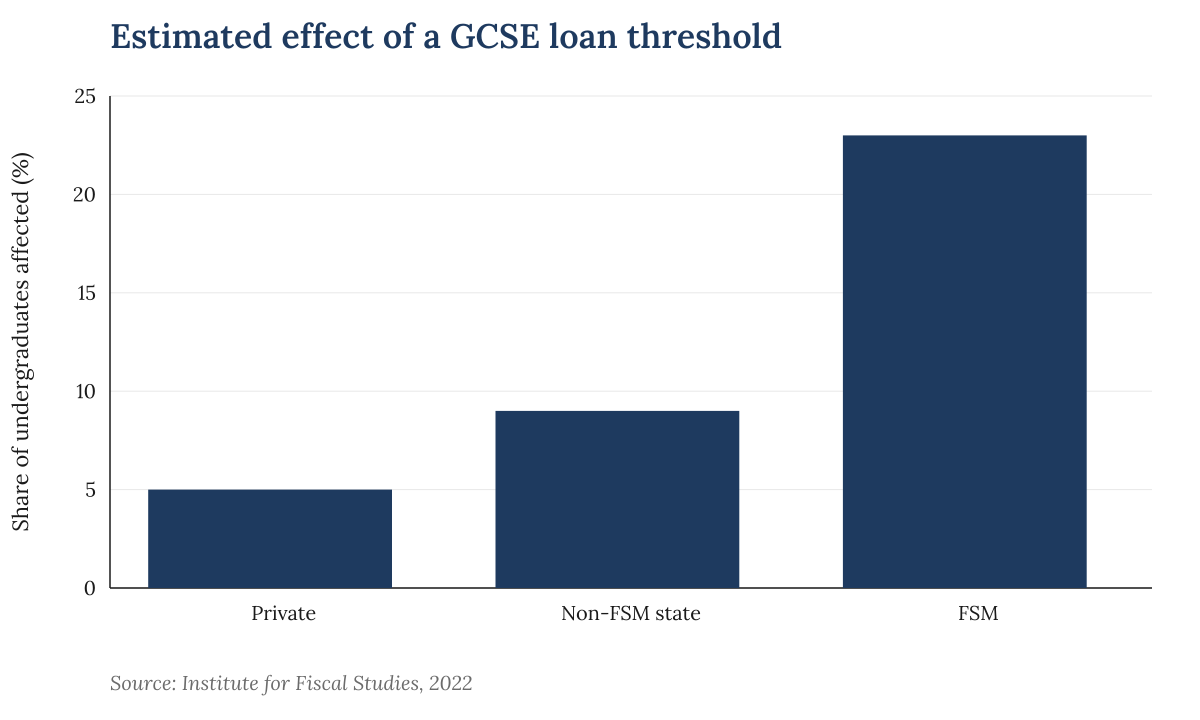 Estimated effect of a GCSE loan threshold. Source: Institute for Fiscal Studies, 2022.