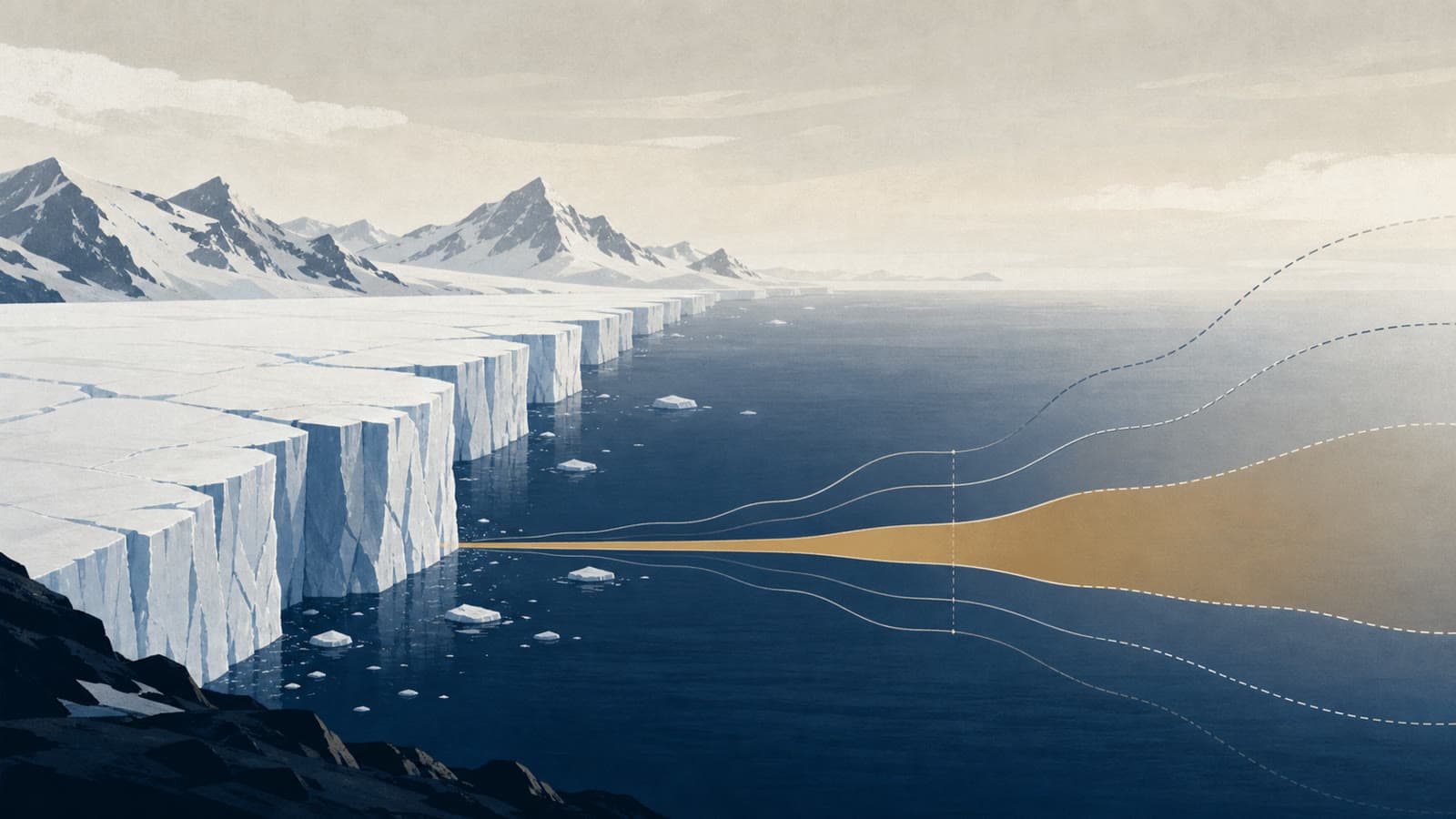
The finding is not a reassurance that Antarctic risk has become small. It is a narrower and more useful claim: coastal planners may have a clearer 10-to-50-year window than they have at 2100. Nature published the paper, "Emergent decadal predictability in Antarctic contribution to sea-level rise", by Felicity McCormack, Mathieu Morlighem, Frank Pattyn, Alex Robel and Helene Seroussi, in its 18 June issue. The authors describe Antarctic projections as diverging widely by 2100 while still showing a robust link between current rates of ice loss and mid-century sea-level contribution.
That distinction matters because ports, drainage systems, sea walls and insurance models are not built on a single timescale. The Intergovernmental Panel on Climate Change's Special Report on the Ocean and Cryosphere said future sea-level change raises risks for low-lying islands, coasts, cities and settlements. Local authorities often need decisions inside the lifetime of a bridge or a flood-defence programme, while national climate scenarios run to 2100 and beyond.
The Nature paper's mechanism is a modelling one. The authors analysed Antarctic ice-sheet projections and asked how strongly the rate of sea-level change in 2025 predicts the rate in later years. In the paper's Figure 2, they compare 2025 and 2055 rates across model ensembles and track how the coefficient of determination, a measure of how much of the variation is explained by the present-day rate, changes through the century. The relationship remains useful on decadal horizons, then erodes as the system moves further away from present conditions.
The Australian Research Council Special Research Initiative for Securing Antarctica's Environmental Future, which publicised the research, framed the result as about a planning runway. Its research note said Antarctic ice loss remains predictable for decades, which could support coastal resilience planning, but that predictability begins to fray beyond mid-century and dissolves by roughly 2080 as more complex feedback mechanisms take hold.