Tesco Corporate Treasury Services notified the market on 18 June that Tesco PLC had released its Q1 2026/27 trading statement through the London Stock Exchange. Tesco's own trading statement said group sales excluding VAT and fuel were GBP16.826bn for the 13 weeks to 30 May 2026, with like-for-like group sales up 1.0%.
The UK and Ireland business reported GBP13.438bn of sales and 1.8% like-for-like growth. The UK alone recorded GBP12.6bn of sales and 1.8% growth, while Ireland grew 3.3%. Booker, the wholesale arm, went the other way, with sales of GBP2.246bn and a 3.2% like-for-like decline. Central Europe rose 0.8% to GBP1.142bn.
The slowdown is visible against Tesco's own April results. In its preliminary statement for 2025/26, Tesco said UK like-for-like sales rose 4.2% in the fourth quarter. The Guardian reported that the first-quarter UK figure was less than half that pace, and that City analysts had expected 2.3%.
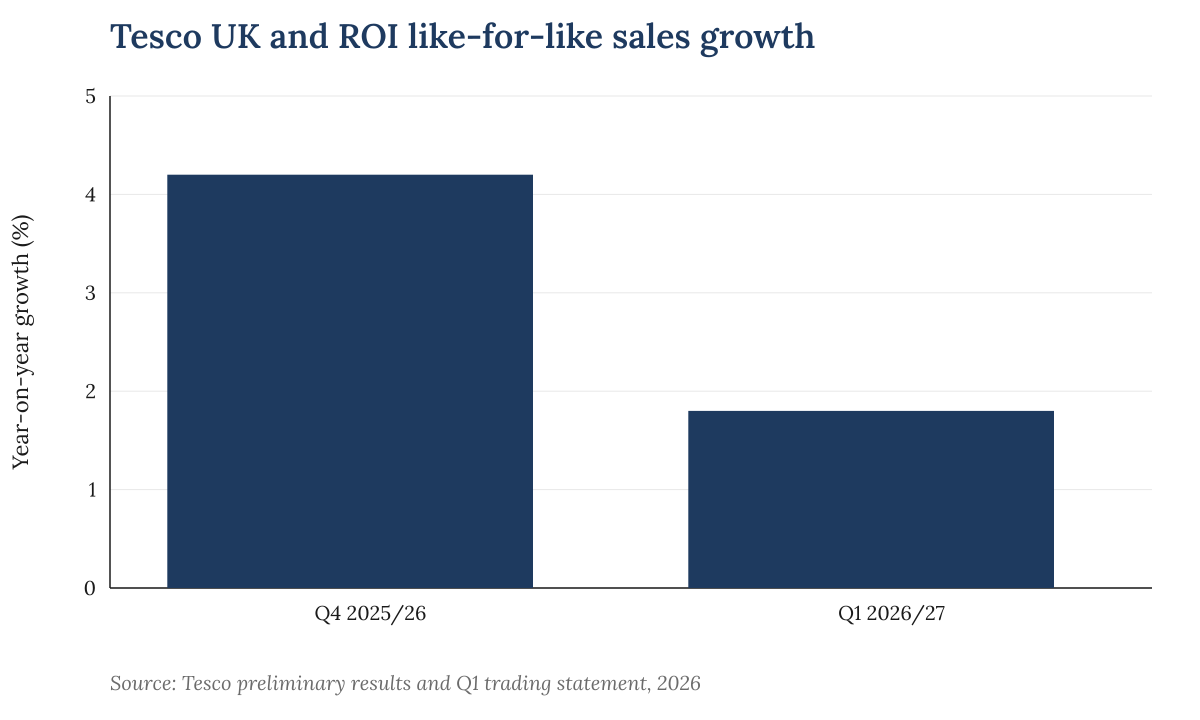 Tesco UK and ROI like-for-like sales growth. Source: Tesco preliminary results and Q1 trading statement, 2026.
The quarter was still not weak in every channel. Tesco said UK online sales rose 8.9%, food sales rose 2.6%, fresh food sales rose 3.6% and Finest sales rose 9%. The Wall Street Journal also reported that online growth helped support the group figure, with UK online sales up 8.9% and Central Europe online sales up 17%.
The composition matters because grocery sales growth can come from very different places. A retailer can expand through higher prices, more transactions, larger baskets, online penetration or market-share gains. Tesco's update points to a business still using product range, fresh food and online convenience to defend growth, even as the headline UK number shows less momentum than the previous quarter.