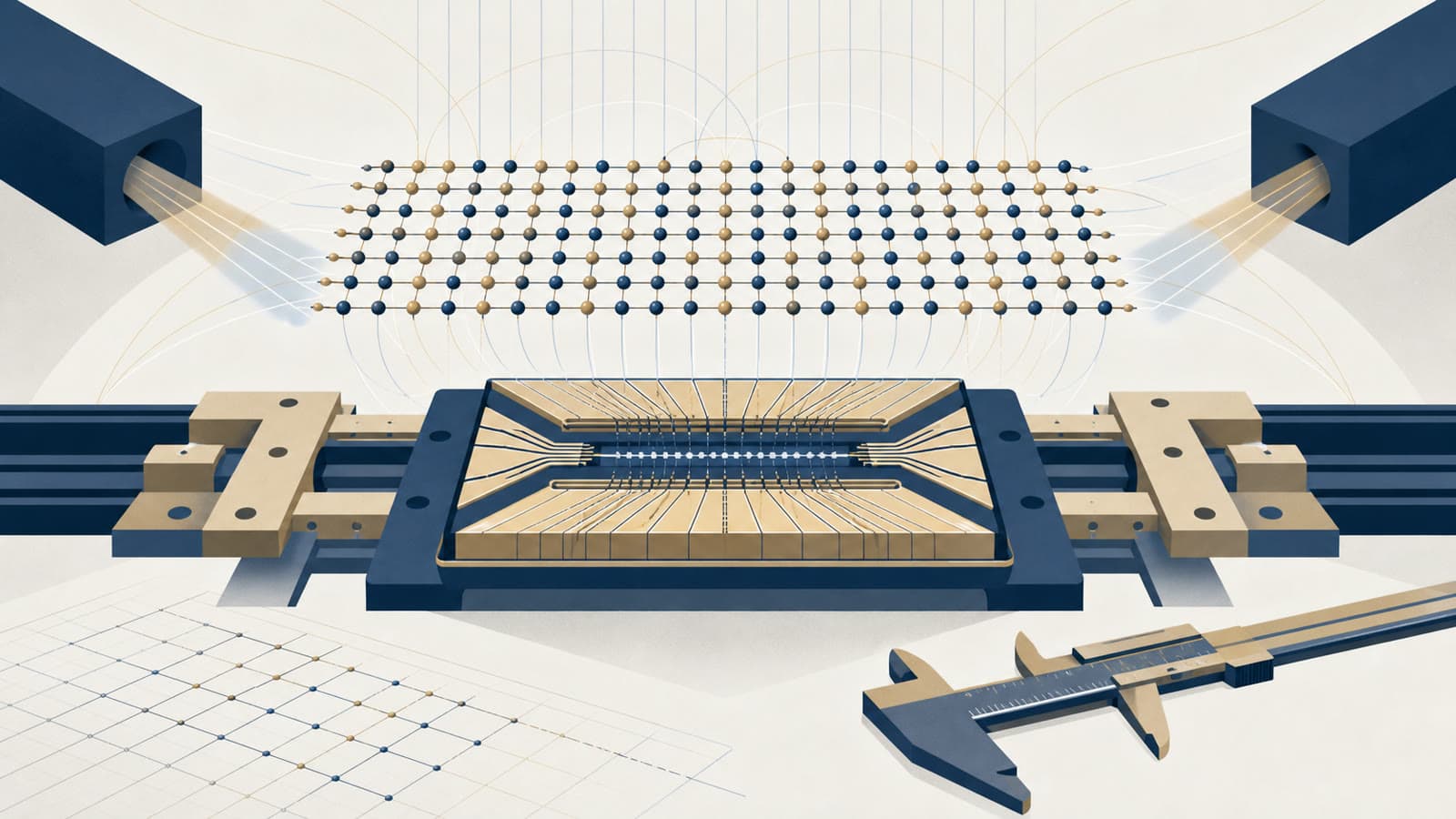
Lead author Anthony Ransford and a large Quantinuum-led team write that trapped-ion systems have shown high gate fidelities, but that scaling to larger qubit numbers while preserving performance has remained a central challenge. Helios is their answer to that engineering problem: barium-137 hyperfine qubits, two quantum-operation regions, and all-to-all connectivity enabled by a rotatable ion storage ring connected through a junction.
In plain terms, the design moves ions around rather than leaving every qubit fixed in place. The Nature paper says the processor uses memory regions and logic regions, with ions transported to operation zones for gates. That matters because a fixed layout can force extra operations simply to bring qubits together; extra operations create more chances for error.
Infidelity is the error probability expressed in the language of quantum-control experiments. A lower number means the operation more often produces the intended quantum state. The relevant comparison is not with a laptop bit flip, but with the threshold demanded by error-correction schemes that must combine many imperfect physical operations into fewer reliable logical operations.
That is why the two-qubit figure carries particular weight. Entangling gates are usually the harder operations, and algorithms need many of them. A processor with more qubits but weak two-qubit operations would scale the headline number while losing the computation to accumulated error.
Table: What Helios reports
| Measure | Reported value | Why it matters |
|---|---|---|
| Physical qubits | 98 | Scale of the trapped-ion processor |
| Architecture | QCCD | Moves ions between memory and logic regions |
| Average single-qubit gate infidelity | 2.5(1) x 10^-5 | Error rate for one-qubit operations |
| Average two-qubit gate infidelity | 7.9(2) x 10^-4 | Error rate for entangling operations |
| Average SPAM infidelity | 3.3(5) x 10^-4 | Error in state preparation and measurement |