
The verified policy frame is clear. Brussels wants faster access to raw materials for clean technology, digital industries, aerospace and defence. The question is whether the water protections built to guard river basins and aquifers survive the same compression now being applied to mineral supply chains.
The Critical Raw Materials Act explains the industrial pressure. The Commission says critical raw materials are indispensable for strategic sectors and that demand is rising with decarbonisation. Its own page says EU demand for rare earth metals is expected to increase six-fold by 2030 and seven-fold by 2050, while lithium demand is expected to rise twelve-fold by 2030 and twenty-one-fold by 2050.
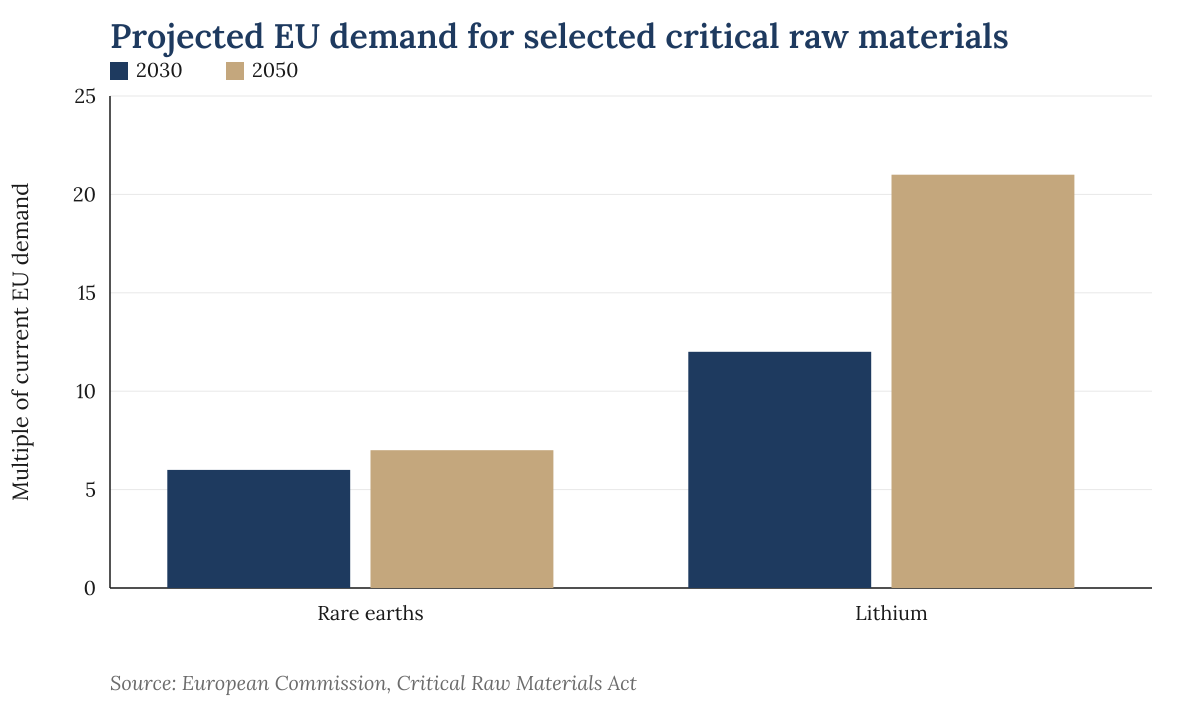 Projected EU demand for selected critical raw materials. Source: European Commission, Critical Raw Materials Act.
The Commission also sets 2030 benchmarks of at least 10% of annual EU consumption from extraction, 40% from processing and 25% from recycling, with no more than 65% of annual consumption from a single third country. Those targets are meant to reduce strategic dependency. They also push the EU toward more domestic extraction, including projects whose local impacts are governed by environmental law rather than industrial strategy alone.
The water regime was built for a different purpose. The Commission's Water Framework Directive page describes the law as the main European water-protection framework since 2000, applying to inland, transitional and coastal surface waters and to groundwater. It requires member states to protect and, where necessary, restore water bodies and prevent deterioration.