The useful lesson is not that one policy can claim the whole gain. City Hall's own notes say the study does not isolate the effect of the Ultra Low Emission Zone, or any single intervention, and instead compares a 2019 snapshot with a 2024 snapshot under an updated mortality-burden method. That makes the result an accountability test for the whole clean-air programme: pollution has fallen, the estimated health burden has fallen with it, and the remaining harm is still measured in thousands of early deaths.
The Greater London Authority said the new Imperial analysis put the 2019 mortality burden at 6,400 to 8,000 premature deaths, after applying updated evidence and data to the earlier baseline. For 2024, the estimate falls to 3,800 to 5,100. The Guardian also reported the figures on Wednesday, citing the Imperial team and City Hall's release.
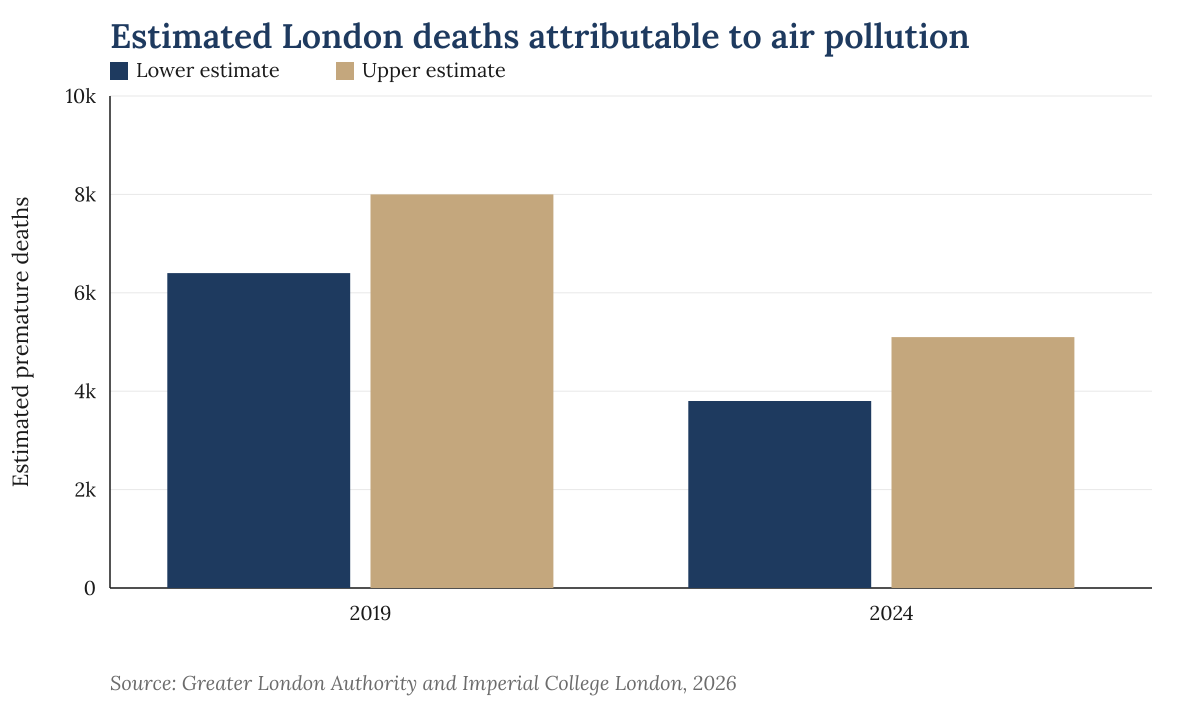 Estimated London deaths attributable to air pollution. Source: Greater London Authority and Imperial College London, 2026.
The revision matters because it changes the baseline as well as the trend. City Hall said the 2021 Imperial assessment had put the 2019 burden at the equivalent of 3,600 to 4,100 attributable deaths, using the evidence available then. The new study says that earlier figure was an underestimate when judged against stronger epidemiological evidence, newer pollution modelling and 2021 Census data. Comparing the old 4,000 figure directly with the new 2024 estimate would therefore flatter the progress; the fairer comparison is the updated 2019 range against the updated 2024 range.
The pollution measures point in the same direction. The City Hall release said modelled population-weighted annual mean nitrogen dioxide concentrations were down 41% between 2019 and 2024, while fine particulate matter, or PM2.5, was down 28%. Nitrogen dioxide is closely associated with road traffic; PM2.5 is made up of particles small enough to enter the lungs and bloodstream, with sources including transport, wood burning, construction and commercial cooking.
That mix is why the policy reading is more complicated than the headline. Sadiq Khan, London's mayor, presented the findings as evidence that the city's clean-air policies had saved lives, and the release listed the central London ULEZ launched in 2019, the 2021 inner-London expansion and the 2023 London-wide expansion among the measures. It also cited cleaner buses, vehicle scrappage support, school air filters and the Mayor's Air Quality Fund. But the notes to editors say the mortality study models the total effect of all factors influencing pollution, including long-term trends and multiple policy interventions, not a single-policy counterfactual.
That distinction is not a footnote. A cleaner vehicle fleet, national emissions rules, changes in travel patterns, local traffic schemes and wider economic shifts can all move pollution concentrations. The London result is still a policy success if sustained action helped push the city in the right direction; it is weaker evidence for any claim that one scheme alone produced the whole reduction.