
Al Jazeera reported the result as China taking the US crown in the ranking of the world's fastest supercomputers. That is fair as far as the TOP500 list goes. It is also incomplete unless the benchmark is kept in view: TOP500 ranks submitted systems by their measured performance on high-performance LINPACK, not by every useful property of a modern machine.
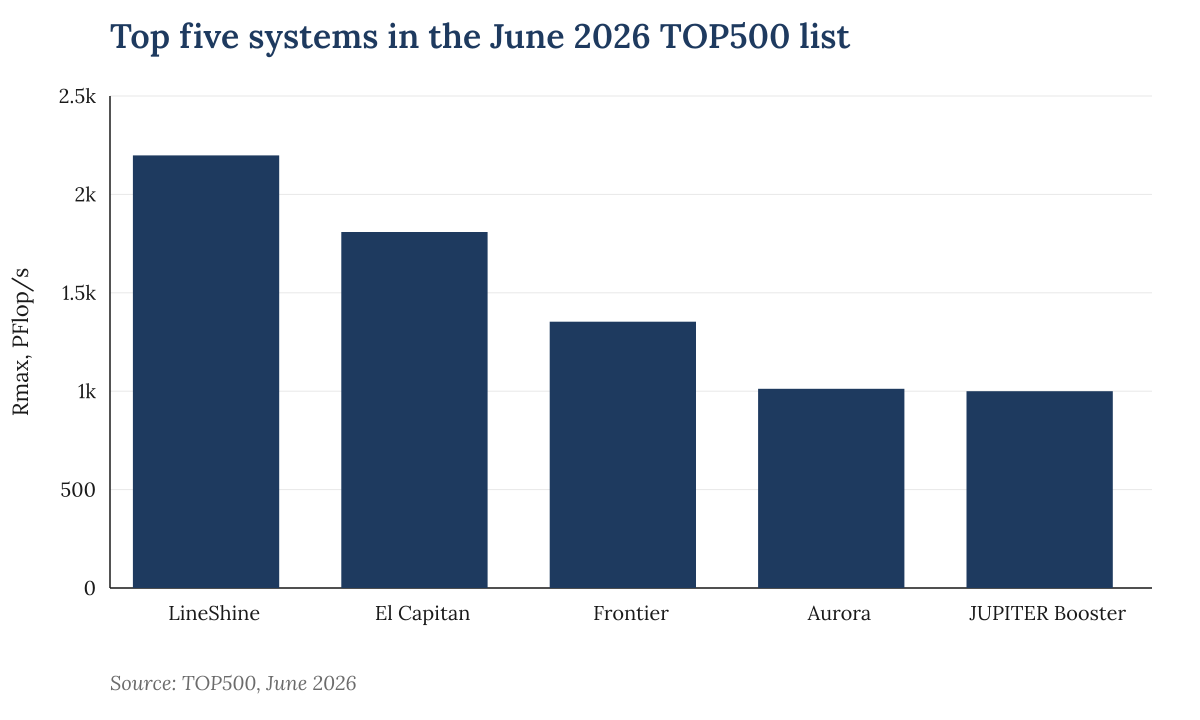 Top five systems in the June 2026 TOP500 list. Source: TOP500, June 2026.
The headline numbers are large enough to justify attention. TOP500 lists LineShine with 13,789,440 cores, an Rmax of 2,198.40 PFlop/s and a theoretical Rpeak of 2,735.82 PFlop/s. It says the machine is based on the custom LingKun platform, 304-core LX2 processors at 1.55GHz, the LingQi interconnect and Kylin OS, and that it was built by the Shenzhen Cloud Computing Center. The list gives LineShine a power figure of 42,220 kW.
The next four systems are still exascale-class machines. TOP500 places El Capitan second with an Rmax of 1,809.00 PFlop/s, Frontier at Oak Ridge National Laboratory third with 1,353.00 PFlop/s, Aurora at Argonne National Laboratory fourth with 1,012.00 PFlop/s and Germany's JUPITER Booster fifth with exactly 1,000.00 PFlop/s. In TOP500's telling, LineShine is the first China-based system to lead the list since Sunway TaihuLight in 2017.
The measurement matters because LINPACK is precise but narrow. TOP500 explains that the LINPACK benchmark measures how fast a system solves dense systems of linear equations. It is a long-running way to compare high-performance computing systems on a common test, and it is the basis on which the list is ordered. A machine that leads LINPACK has demonstrated formidable floating-point performance on that workload.