
The Guardian reported on Friday that boys in UK secondary schools were disproportionately continuing with primary-level titles, including Jeff Kinney's Diary of a Wimpy Kid series, while girls' choices broadened more quickly. The findings came from Renaissance's annual What Kids Are Reading report, which the Guardian said drew on more than 23 million reading quizzes completed by almost 1.1 million children in schools across the UK and Ireland during the 2024-25 academic year.
That dataset is large, but it is not a national census of every book a child reads. Renaissance's report is built from quizzes taken through its school reading platform, so it captures a particular slice of school-mediated reading. It still matters because the pattern appears inside the institutions most able to respond: classrooms, libraries and reading programmes.
The wider picture is not simply decline. The National Literacy Trust's 2026 reading report, based on responses from 125,375 children and young people aged five to 18 in 479 UK schools, found that 36.1% enjoyed reading in their free time, up from 32.7% in 2025. Daily reading among eight- to 18-year-olds also rose, to 20.3% from 18.7%. The trust described the increase as modest and warned that longer-term levels remain low.
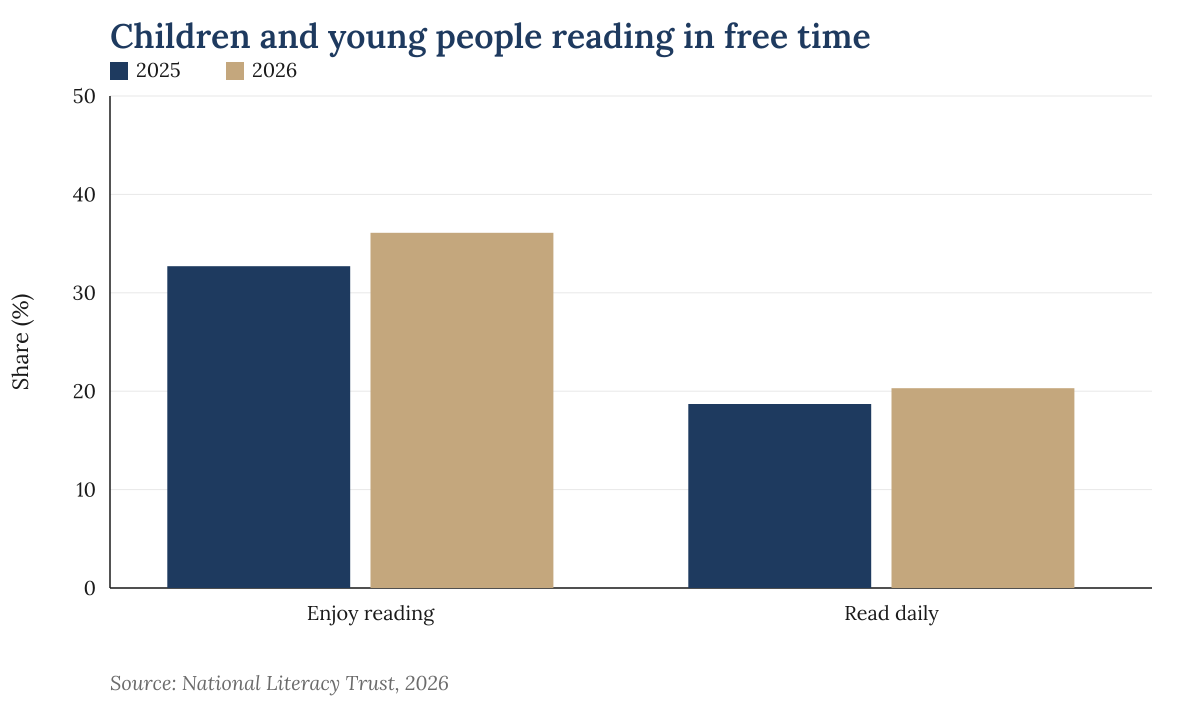 Children and young people reading in free time. Source: National Literacy Trust, 2026.
For schools, those figures point in two directions at once. There is evidence that reading engagement can recover. There is also evidence that the recovery is fragile, uneven and vulnerable to the early-adolescent drop that the National Literacy Trust's separate teenage-reading report has tried to reframe. That report, based on more than 80,000 young people aged 11 to 16 in 2025, argued that teenage reading should be understood through motivation, access and identity, not only through whether pupils say they like books.