Justice Brett Kavanaugh wrote the 7-2 opinion for the Court, joined by Chief Justice John Roberts and Justices Clarence Thomas, Samuel Alito, Sonia Sotomayor, Elena Kagan and Amy Coney Barrett. Justice Thomas wrote separately. Justice Ketanji Brown Jackson dissented, joined by Justice Neil Gorsuch.
The case came from John Durnell, who sued Monsanto in Missouri state court in 2019. The Supreme Court opinion said Durnell alleged that he had used Roundup for about 20 years, developed non-Hodgkin's lymphoma, and should have been warned of cancer risks. A Missouri jury awarded him more than $1mn on the failure-to-warn theory, and the Missouri Court of Appeals rejected Monsanto's federal-preemption defence before the Supreme Court took the case.
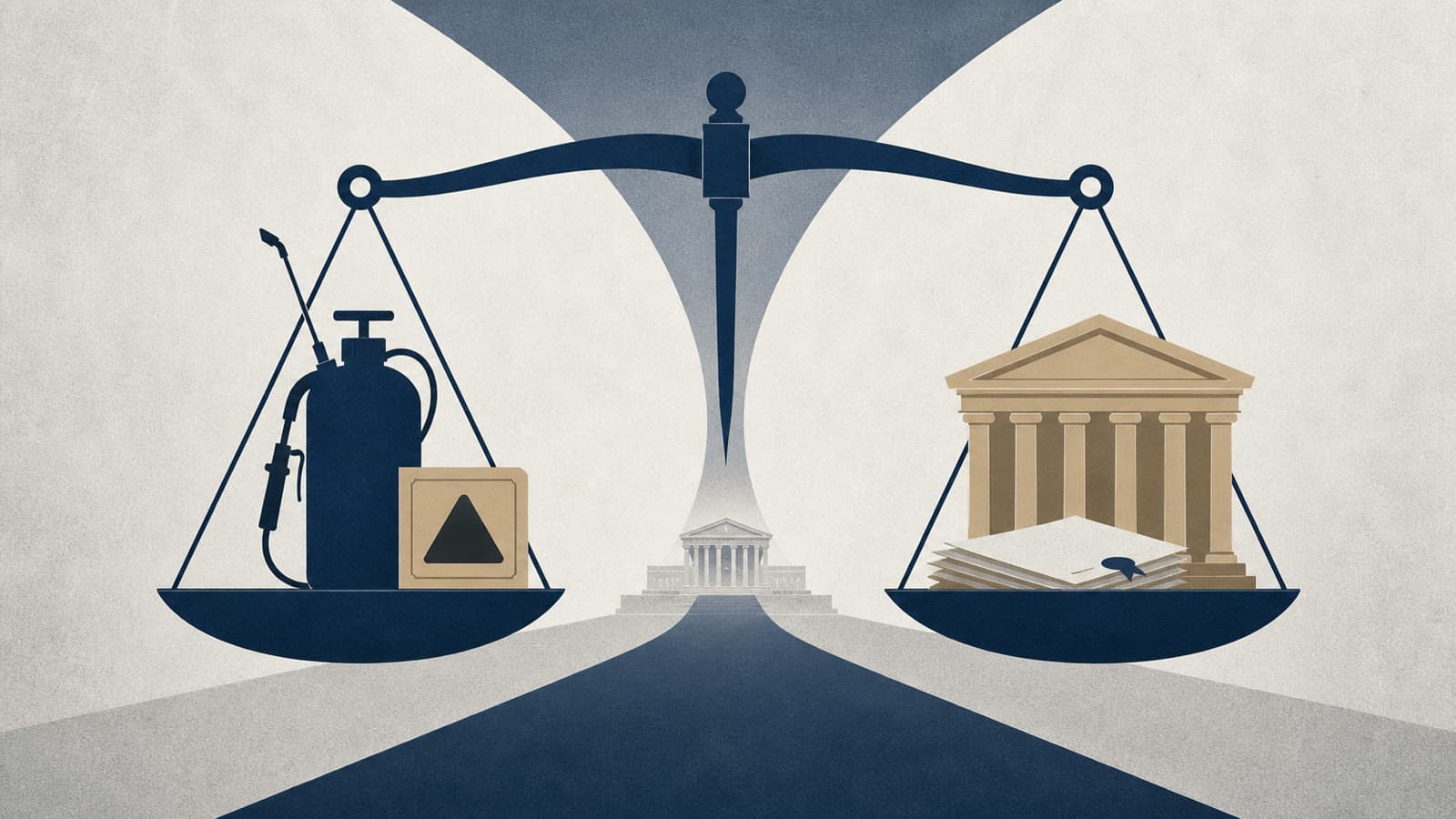
The legal question was not whether glyphosate causes cancer. It was whether the Federal Insecticide, Fungicide, and Rodenticide Act, known as FIFRA, lets state tort law impose a warning requirement that is additional to or different from the federal label. The Court said it does not, where the EPA-approved label does not require that cancer warning.
Kavanaugh's opinion leaned on the structure of EPA label approval. The Court said the Environmental Protection Agency must evaluate a pesticide and its proposed label, determine whether warnings are necessary and adequate, and require the manufacturer to use the approved label unless the agency approves or requires a change. The EPA's own glyphosate materials say the agency has evaluated glyphosate under federal pesticide law; the Court treated the agency's label decision as the operative federal requirement for the preemption analysis.
That gives pesticide manufacturers a clearer defence against state failure-to-warn suits when the warning demanded by a plaintiff conflicts with the EPA-approved label. CBS News reported that the decision sided with Monsanto in litigation over alleged cancer risks from Roundup. Bayer, which owns Monsanto, said the decision should help contain warnings-based Roundup claims and pointed to the majority's conclusion that FIFRA preempts Durnell's claim.
The dissent saw a different danger. Jackson argued that the majority gave too much force to agency label approval and too little to state tort law's role in responding to injury claims. That disagreement is the legal hinge: whether uniform federal labelling protects a national regulatory scheme, or whether it shuts off state-law accountability even when plaintiffs say the label failed to warn them.