
The headline number is dramatic because chip-node names sit at the edge of physics and marketing. IBM itself said transistor nodes now refer to a generation of manufacturing technology rather than an exact physical dimension. The useful question is therefore not whether every feature is literally smaller than one nanometer. It is whether the nanostack architecture can move from research validation to a foundry roadmap.
IBM said the new design packs nearly 100bn transistors onto a chip the size of a fingernail, nearly twice the density of the 2nm chip it announced in 2021. The company said published technical results project up to 50% more performance or 70% greater energy efficiency than its 2nm node chips, and that separate VLSI 2026 work demonstrated 40% SRAM scaling.
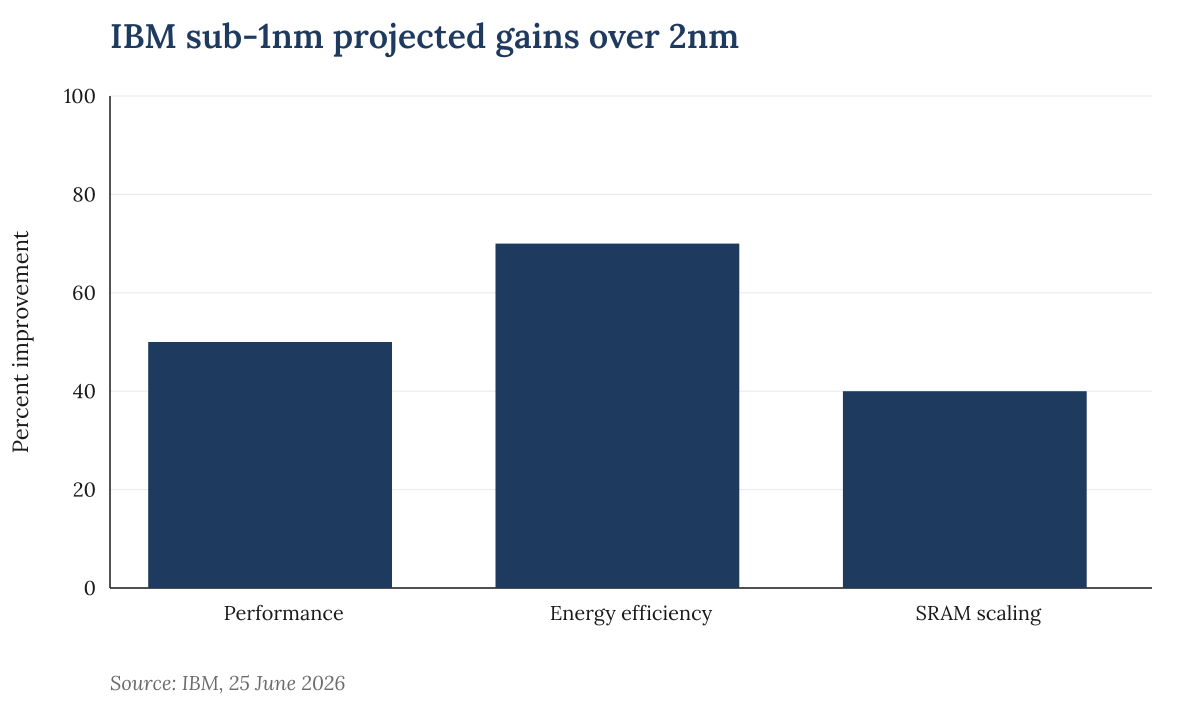 IBM sub-1nm projected gains over 2nm. Source: IBM, 25 June 2026.
Those are IBM's projections and demonstrations, not shipped product benchmarks. The distinction matters. A research wafer can show that a transistor architecture can be built and switched. A commercial node must be manufacturable at yield, cost and reliability levels that customers can use for processors, accelerators or mobile chips.
The architecture is the technical hinge. IBM said nanostack vertically stacks and staggers nanosheet-based transistors, using 3D sequential integration to place more devices in a given area. The company said the approach also allows different material combinations in each stacked layer, so performance and power can be tuned independently across the stack.
That is a plausible route past the limits of simply shrinking planar dimensions. It is also a hard manufacturing problem. More vertical integration means more process steps, more thermal and alignment constraints, and more opportunities for defects. IBM said its researchers had validated the architecture through ultra-thin dielectric bonding, dual-channel engineering and functional CMOS inverter operation with expected switching performance. Those are necessary milestones. They are not the same as a high-volume production process.