Governor Spencer Cox's office said on 25 June that an executive order had allowed the state forester to restrict fireworks statewide through 5 July, while still letting municipalities and fire officials designate areas where fireworks can be used safely. The order sits on a blunt premise: the governor's office said more than 75% of Utah's wildfires this season had been caused by people, with prolonged drought, critically dry vegetation and extreme weather making the landscape unusually volatile.
The Associated Press reported that Cox had declared a state of emergency as the Cottonwood Fire in southern Utah became the largest active wildfire in the United States. The fire had grown to more than 112 square miles, roughly 71,700 acres, was burning unchecked, damaged Eagle Point ski resort and forced mandatory evacuations, AP said.
That scale changes the politics of prevention. Fireworks restrictions can look symbolic when they arrive as annual warnings. This one lands while crews are already stretched. KUER, citing the executive order, reported that 354 wildfires had started in Utah and burned 141,743 acres when the emergency declaration was issued.
Those two numbers explain why the order focuses on human starts rather than spectacle. A single new ignition can draw crews, aircraft and evacuation resources away from fires already moving through dry fuels.
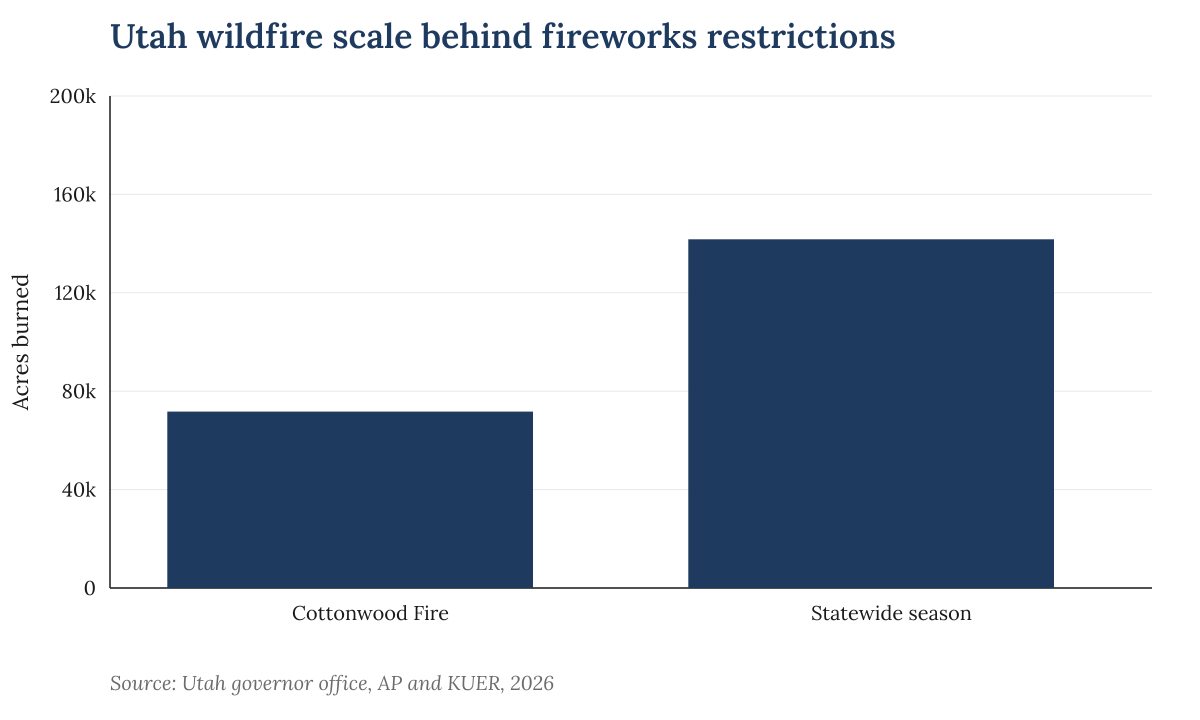 Utah wildfire scale behind fireworks restrictions. Source: Utah governor's office, AP and KUER, 2026.
The legal design is deliberately local as well as statewide. Cox's office said the executive order does not create a blanket ban on every celebration. Instead, the state forester can prohibit fireworks in high-risk areas, while cities and local fire authorities can identify safer zones where conditions and response capacity permit use. That gives local officials room to protect public events without treating a desert subdivision, a city park and a dry wildland edge as the same risk.