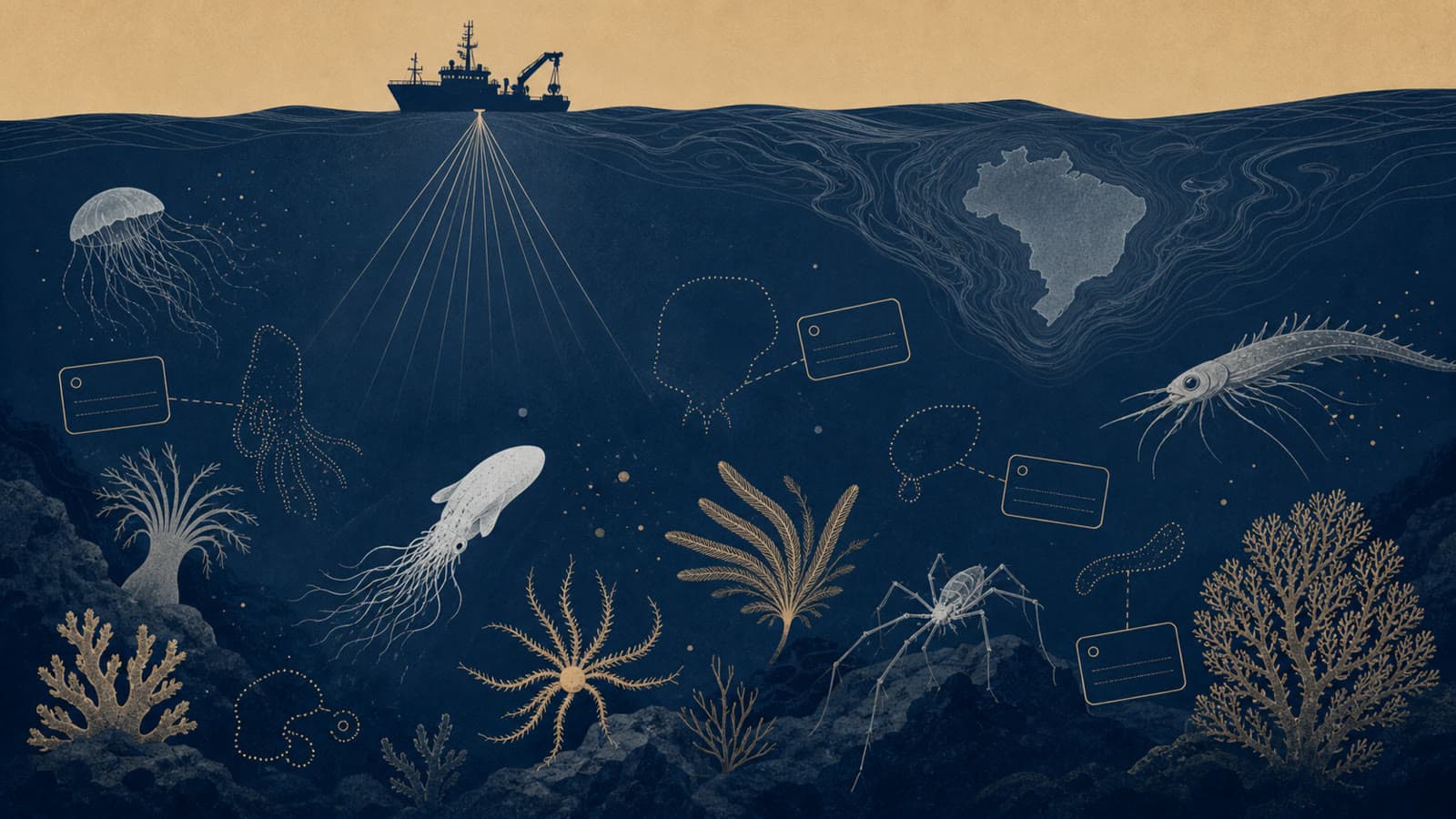
The Guardian reported on 26 June that the expedition uncovered 31 new species in international waters off Brazil. Schmidt Ocean Institute's release said an international team aboard the research vessel Falkor (too) used advanced imaging, remotely operated vehicle work and onboard genetic analysis to explore the midwater, which it described as Earth's largest and least explored habitable ecosystem.
The list is not a single kind of creature with a simple headline attached. Schmidt Ocean Institute said the newly identified organisms included nine jellyfish, seven siphonophores, seven comb jellies, four larvaceans, two giant rhizarians, an amphipod and a gossamer worm. Bigelow Laboratory for Ocean Sciences, whose researchers took part in the work, said the expedition used the vessel Falkor (too) and documented life in the tropical South Atlantic, including animals sampled at depth by ROV SuBastian.
The scientific value is in the method as much as the count. Schmidt Ocean Institute said the team combined high-resolution imagery with genome sequencing from collected specimens, allowing scientists to identify new species far faster than traditional workflows usually permit. The institute also said a microscope system nicknamed Squid let researchers observe living 3D cellular structures at sea for the first time on a ship.
That combination matters because many deep-sea organisms are known from damaged fragments, old records or brief observations. A specimen can tell one part of the story; video of how it moves, feeds or interacts with other organisms can tell another. The expedition's claim is therefore not only that it found more animals, but that it captured better evidence about animals that are usually hard to study intact.
That does not make taxonomy instantaneous. Expedition announcements compress a long scientific process into a public headline, and formal species descriptions can still require peer-reviewed publication, specimen deposition and comparison with known organisms. The stronger version of the claim is also the more interesting one: scientists found organisms they could confirm as new during the cruise, while the full taxonomic record will take longer to settle.