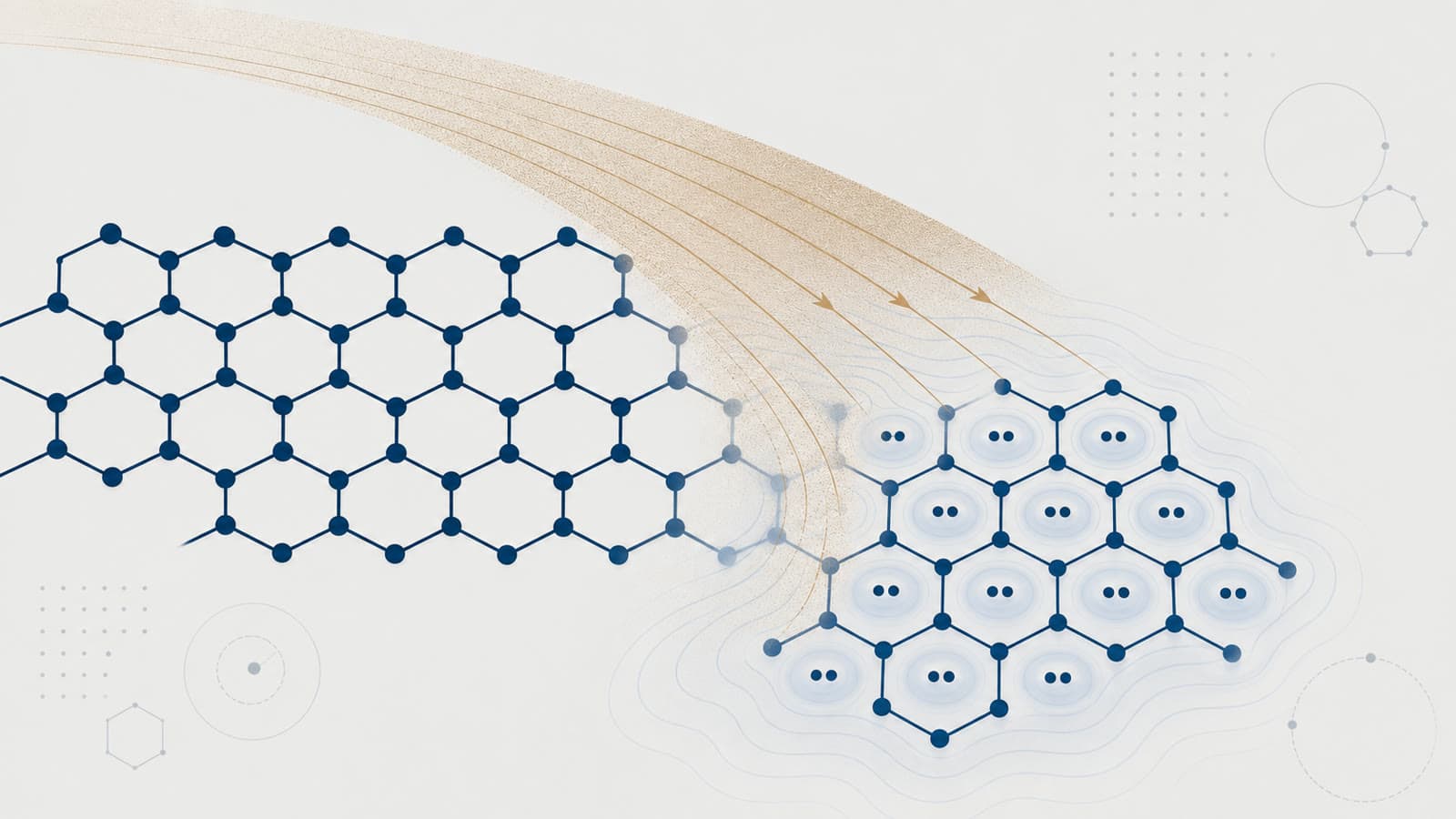
Nature published a paper on 29 June reporting a "family of magnetic field-boosted superconductors in rhombohedral graphene". The authors studied four- and five-layer rhombohedral graphene, a form of stacked carbon sheets whose electronic structure can be tuned by changing carrier density and applied fields. In the five-layer system, the paper reports superconductivity that is strengthened by an in-plane magnetic field and remains robust up to 8.5 tesla.
A companion arXiv preprint extends the same experimental map into six-layer rhombohedral graphene. It reports that a small in-plane field can induce a superconducting state along a phase boundary and that the state persists up to 14 tesla, well beyond the conventional Pauli limit.
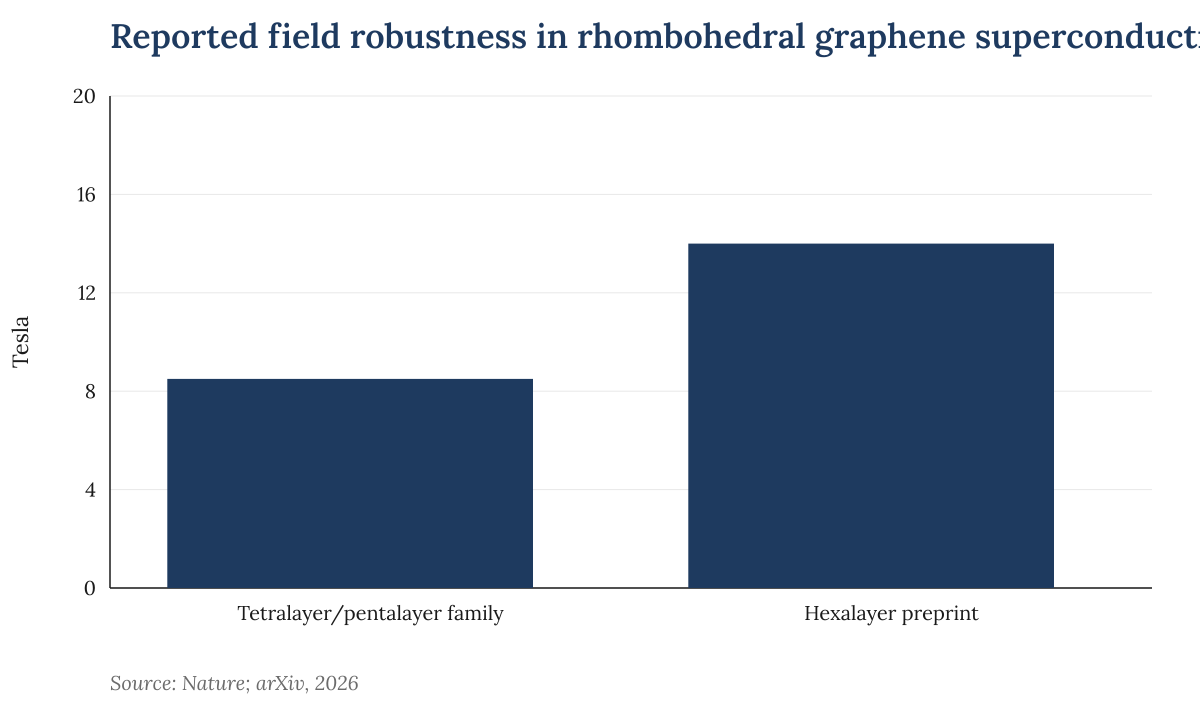 Reported field robustness in rhombohedral graphene superconductivity. Source: Nature; arXiv, 2026.
The Pauli limit is a rule of thumb for conventional superconductors: at a strong enough magnetic field, the spin alignment forced by the field should break the usual spin-singlet electron pairs. Surviving well past that limit does not by itself identify the mechanism, but it is a strong clue that the paired state is unconventional. The hexalayer preprint interprets the result as evidence for spin-polarised, spin-triplet-like pairing linked to a nematic reconstruction of the Fermi surface, meaning the electrons' momentum-space pattern appears to choose a direction rather than remaining rotationally symmetric.
That is the finding the earlier title-level version of the story would have missed. The result is not merely that graphene superconductivity is complicated, or that magnetic fields can alter a phase diagram. It is that a field, usually an enemy of superconductivity, appears to stabilise a state whose behaviour strains the standard spin-singlet picture.
Rhombohedral graphene is useful because it is tunable. Graphene is a one-atom-thick sheet of carbon; rhombohedral stacking arranges multiple sheets in an offset order that changes how electrons move. Researchers can alter layer count, carrier density, electric displacement field and magnetic field, then watch which electronic phases appear. That makes the material less like a candidate product and more like a clean experimental board on which competing theories can be tested.