The Guardian reported that London-Birmingham trains may not run until as late as 2039, about 13 years later than originally promised, and that the latest forecast is roughly GBP 70 billion above the original estimate. Those numbers are the reason the watchdog's warning matters: this is not a tidy reset of a marginal programme, but an attempt to recover one of Britain's most visible public-spending failures.
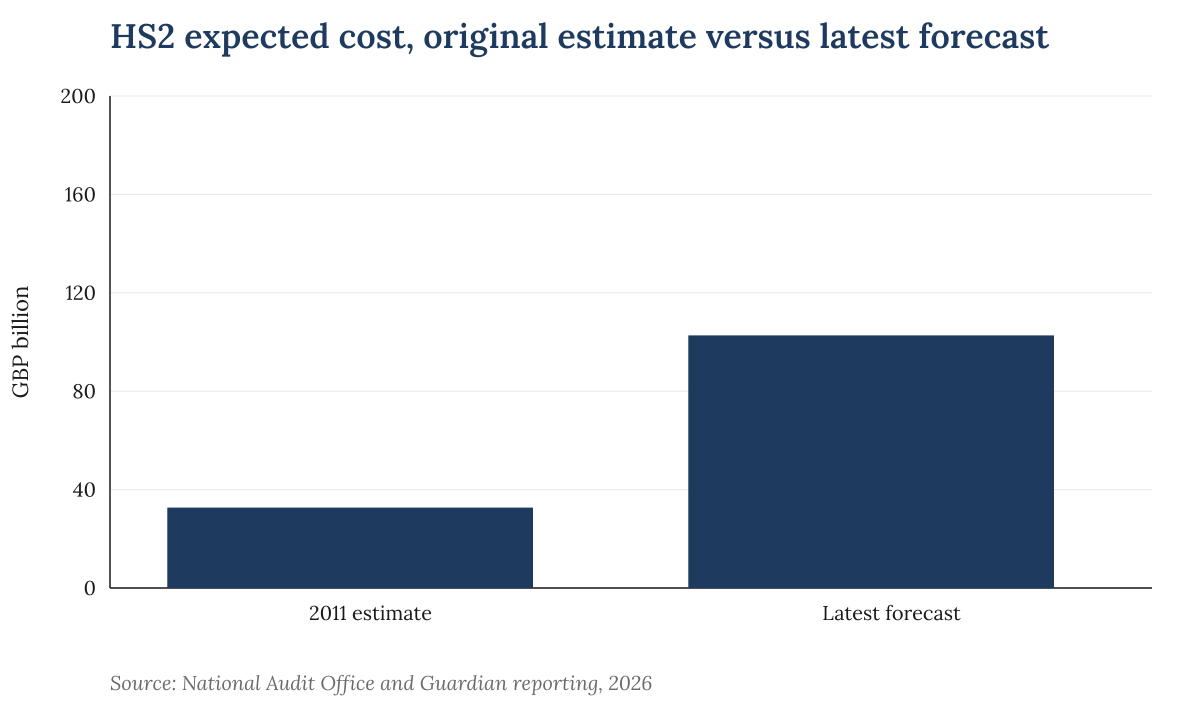 HS2 expected cost, original estimate versus latest forecast. Source: National Audit Office and Guardian reporting, 2026.
The NAO's own HS2 reset report is the controlling document because it sets the audit frame. It says Mark Wild, HS2 Ltd's chief executive, produced the reset plan after a 15-month review, and it puts the cost of the reset process itself at GBP 153 million. The report also points to a spring 2027 target for the government to decide whether the revised baseline is ready to proceed.
That distinction matters. The NAO is not the transport secretary, and it is not deciding the route. Its role is to ask whether Parliament and taxpayers are being given a plan that can be controlled. In a project such as HS2, that means a scope ministers are prepared to stand behind, a budget that matches the chosen scope, a schedule that can survive construction risk, and governance strong enough to stop optimism from becoming policy.
The watchdog attributed past increases to cost underestimation, inefficient delivery and scope changes. That is a more useful diagnosis than a general complaint about big infrastructure. It describes a system in which the stated plan and the deliverable plan drifted apart, leaving ministers to defend a programme whose cost and timetable no longer resembled the original political promise.