The Financial Times reported on June 28 that research by MSCI Carbon Markets put the industry's potential bill at up to $127bn over the life of the Carbon Offsetting and Reduction Scheme for International Aviation, known as CORSIA. In the tight-supply scenario reported by the FT, Emirates could face $8bn of costs, Qatar Airways $6bn and United Airlines $5bn.
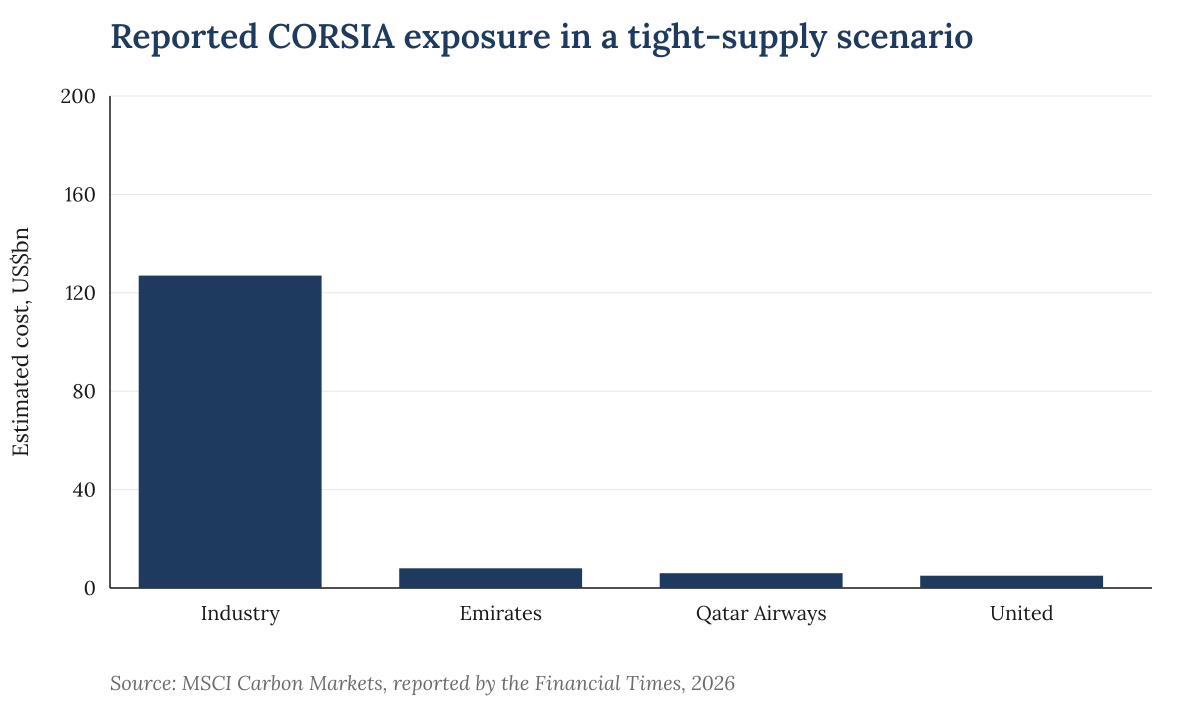 Reported CORSIA exposure in a tight-supply scenario. Source: MSCI Carbon Markets, reported by the Financial Times, 2026.
The sums are scenario estimates, not invoices. But they show why the commercial argument has shifted. The question is no longer whether airlines support an offsetting framework in principle; it is whether the approved credit supply can scale fast enough for the scheme to work without surprising carriers, passengers or investors.
ICAO describes CORSIA as the first global market-based scheme applied to a sector and says it complements emissions reductions from technology, operations and sustainable aviation fuels. IATA says governments adopted the scheme in 2016 to stabilise net carbon dioxide emissions from international aviation, with airlines reporting emissions from 2019 and international flights subject to offsetting obligations from 2021.
The pressure point is eligibility. ICAO says CORSIA emissions-unit programmes are approved by its council after assessment against eligibility criteria, and its current eligible-units document covers the 2021-2023 pilot phase, the 2024-2026 first phase and the 2027-2029 second phase. In plain language, airlines cannot simply buy any carbon credit and count it for compliance.
IATA is explicit about the scarcity problem. It says airlines must buy and cancel eligible emissions units to offset covered emissions above the CORSIA baseline, while states must make sufficient quantities of those units available. It also says host countries have to authorise units for CORSIA through corresponding adjustments, so the same emissions reduction is not claimed both by an airline and by a country's Paris Agreement pledge. That gives airlines an obligation to buy, but leaves governments discretion over whether enough eligible units are released.
This is where an environmental rule becomes a business risk. If supply is narrow and demand rises as long-haul flying grows, the cost of compliance behaves less like a predictable fee and more like a commodity exposure. The FT reported that MSCI's research suggested eligible credit prices could rise almost eightfold to $100 a tonne by 2035 as demand outpaces supply.