
The Guardian reported on June 29 that campaigners and worker-rights experts backed Home Office minister Mike Tapp's proposal to exclude care workers from plans to retrospectively lengthen the route to permanent settlement. The same report said the row had put Tapp at odds with Home Secretary Shabana Mahmood, who had called for him to be removed from his post.
The policy context is the government's immigration white paper, first published in May 2025 and updated in January 2026. The Home Office says the paper is intended to restore control over legal migration, link the immigration system to skills and training, and end reliance on overseas labour in sectors including health and social care. It is a control agenda with an explicit labour-market theory: employers should not use immigration as a substitute for pay, conditions and domestic training.
For care workers already in Britain, the disputed point is settlement. The Guardian said the government's proposal would raise the standard qualifying period for permanent residence from five to 10 years, while workers in "low-skilled or medium-skilled jobs", including social care, would face a 15-year baseline. The article also noted that it had amended an earlier version to clarify that care workers would not simply move from five to 10 years.
That distinction is central. A 10-year route is a longer path to security; a 15-year baseline is a different political signal about the value assigned to work the government itself describes as essential but low-paid and vulnerable to exploitation.
The Home Office white paper gives ministers' case for change. It says the expansion of the Health and Care Worker route to include social care in February 2022 triggered a sharp rise in arrivals through below-degree-level jobs, from 37,000 in 2022 to 108,000 in 2023. It says visas issued for care workers and senior care workers reached 105,000 in 2023, representing 73% of Health and Care Worker visas issued to main applicants.
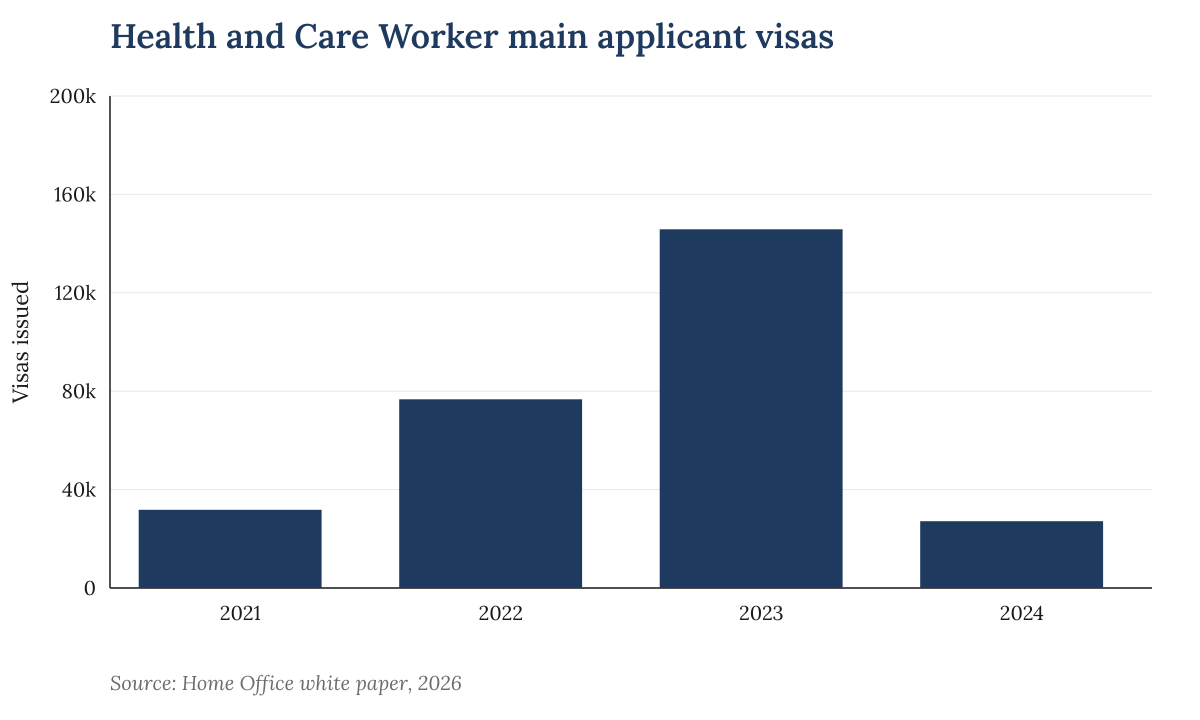 Health and Care Worker main applicant visas. Source: Home Office white paper, 2026.
The same paper says Health and Care Worker main-applicant visas rose from 31,800 in 2021 to 145,823 in 2023, before falling to 27,174 in 2024 after tighter controls. It also says Health and Care Worker dependants numbered 202,334 in 2023 and 83,659 in 2024. Those figures explain why ministers see social care as part of the wider net-migration problem rather than a narrow workforce exception.